In-Depth • Food & Festivals

16 Thai Foods You Shouldn't Miss: Where to Eat Them in Pattaya & Bangkok

By Genext Information Systems Staff

Published 22 July 2026 • 14 min read
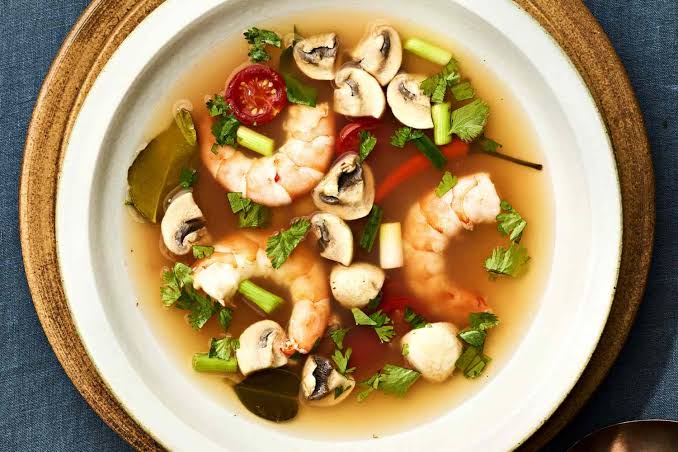
A steaming bowl of tom yum goong with prawns, lemongrass and chilli
Pattaya & Bangkok • Eating Guide

Thailand is one of the few countries where the best meal of your trip is likely to cost less than the taxi that took you there. That is not a slight on the cooking — it is the whole point. Thai food was built in markets and on pavements, where competition is brutal, ingredients are bought that morning, and a vendor who gets the balance of sour, salt, sweet and heat wrong simply doesn't have a queue tomorrow.

This guide covers sixteen things worth eating before you fly home: the famous soups and curries, the noodle plates locals actually order on a Tuesday night, the grilled skewers you'll smell before you see, and the drinks and desserts that make a hot afternoon bearable. For each one we've named specific places to find it in Pattaya and Bangkok — not vague neighbourhoods, but markets, malls and restaurants you can put into a map app.

We've also added realistic 2026 prices, because the gap between a 50-baht plate and a 350-baht plate of the same dish is one of the most useful things to understand about eating here. Planning what a week of this costs? Run your dates and route through ThaiHolidayBudget — food is usually the line item people over-estimate most.
💡 What eating in Thailand actually costs

STREET ฿40–90 a plate • a full day of eating for ฿250–350
SHOPHOUSE ฿80–160 a dish • air-con, menus in English, still cheap
MALL ฿180–400 a dish • plus 7% VAT and often 10% service

Mix the three and most travellers land around ฿500–700 a day on food and drink. Build the full picture — food, room, transport, activities — with the free planner at ThaiHolidayBudget.

The essential list

16 Must-Try Thai Foods, Drinks & Desserts

Ten savoury dishes, two drinks, and four things sweet enough to justify a second dinner. Each with where to find it and what to pay.

Tom yum goong — spicy hot and sour prawn soup
01 • THE ICON

TOM YUM GOONG • ต้มยำกุ้ง

Spicy Hot & Sour Prawn Soup

If Thailand has a national dish, this is it. Tom yum goong is a clear or milky broth loaded with bruised lemongrass, galangal, torn kaffir lime leaves, whole bird's eye chillies and fat river prawns, finished at the last second with lime juice and fish sauce so the sourness stays bright rather than cooked-out. The first spoonful is startling — citrus oil, chilli heat and a savoury depth that comes from prawn heads simmered into the stock.

There are two schools. Nam sai is the clear version, sharper and more aromatic. Nam khon adds evaporated milk and chilli paste for a richer, orange-tinted bowl that most visitors find easier going. Order either with rice on the side; the soup is a seasoning as much as a course.

Do not fish out the lemongrass, galangal and lime leaves and eat them. They are there to perfume the broth — push them to the side of the bowl like everyone else.

PATTAYARimpa Lapin on the Jomtien cliffs for a sunset version, or the food court at Central Festival Pattaya Beach for a fast, cheap one.
BANGKOKNara Thai Cuisine at Siam Paragon is the reliable, polished choice; the shophouse restaurants off lower Sukhumvit do it cheaper and hotter.
PRICE฿80–150 at a market stall • ฿250–450 in a mall restaurant
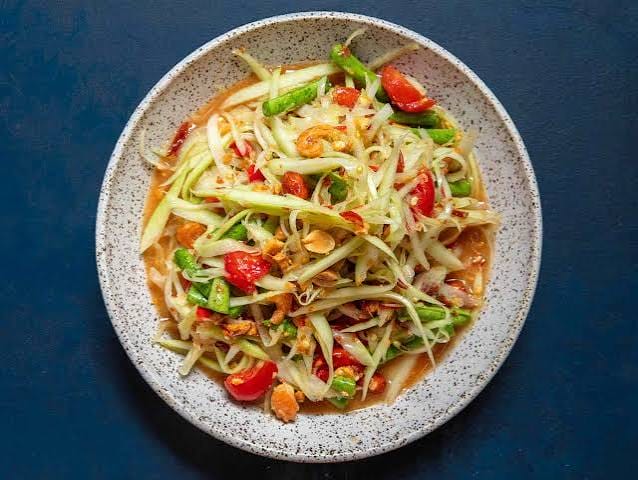
Som tam — green papaya salad pounded with chilli, lime and peanuts
02 • THE LEGEND

SOM TAM • ส้มตำ

Green Papaya Salad

You will hear som tam before you find it — the rhythmic knock of a wooden pestle against a clay mortar carries down an entire street. Shredded unripe papaya is bruised rather than crushed together with garlic, chillies, long beans, cherry tomatoes, palm sugar, fish sauce, lime and roasted peanuts. The papaya stays crunchy; everything else turns into a dressing that is sour, salty, sweet and fiercely hot in roughly that order.

The default is som tam Thai, the peanut-and-dried-shrimp version most visitors love. Braver eaters go for som tam pla ra, made with fermented fish sauce — pungent, deeply savoury and utterly addictive once it clicks. Say "pet nit noi" for mild, and mean it: two chillies is plenty for most people, and vendors routinely start at five.

It is almost never eaten alone. Order it with sticky rice and grilled chicken for the classic trio that half of Thailand eats for lunch.

PATTAYAKai Yok Krok for the grilled-chicken-and-papaya combination, or any of the Isan stalls at Thepprasit Night Market (Fri–Sun).
BANGKOKSom Tam Nua in Siam Square — expect a queue — or the pounding stalls scattered through Chatuchak Weekend Market.
PRICE฿40–70 at a stall • ฿120–200 sit-down
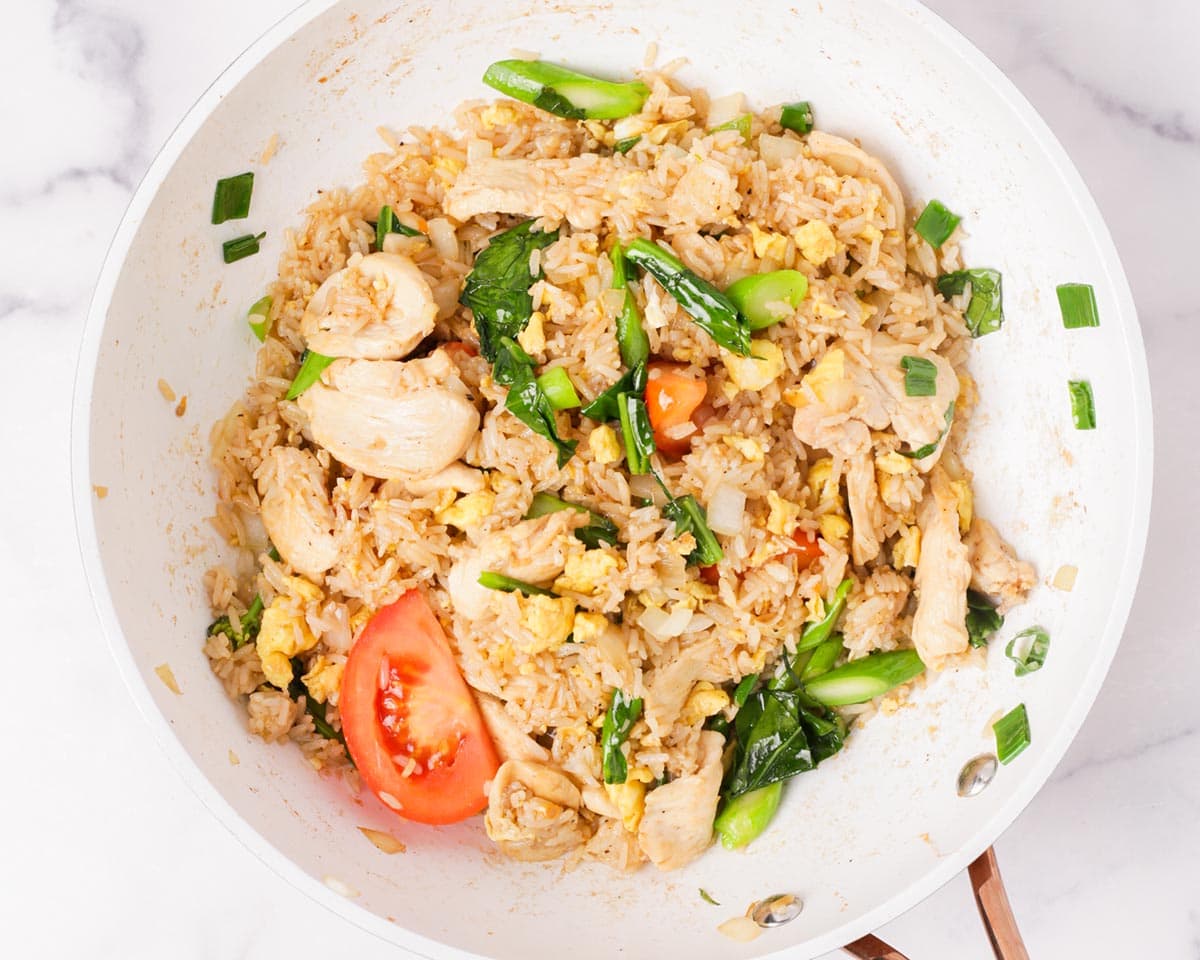
Khao pad — Thai fried rice with prawns and a lime wedge
03 • THE SAFE BET

KHAO PAD • ข้าวผัด

Thai Fried Rice

Khao pad is the dish every traveller falls back on and then quietly grows to love. Thai fried rice is lighter and less sweet than its Chinese cousin: day-old jasmine rice hit hard in a screaming wok with garlic, egg, spring onion, a little soy and fish sauce, and whatever protein you name — chicken, pork, prawn, or crab if you're feeling flush. There's no dark sauce and no gloss, just separate grains carrying the faint smoke of the wok.

What makes it work is the table setup. Every plate arrives with a wedge of lime and a small dish of prik nam pla — sliced chillies floating in fish sauce. Squeeze the lime over everything, spoon on the chilli fish sauce, and a plain plate becomes something with edges.

Add a fried egg on top (khai dao) for 10–15 baht. Break the runny yolk into the rice. It is the single best value upgrade in Thai cooking.

PATTAYAThe wok stalls at Tree Town night market on Soi Buakhao, or MAYs Pattaya for a tidier crab fried rice.
BANGKOKThe stall clusters around Victory Monument, or the late-night shops near Thipsamai on Maha Chai Road.
PRICE฿50–80 street • ฿150–250 restaurant • crab ฿250–450
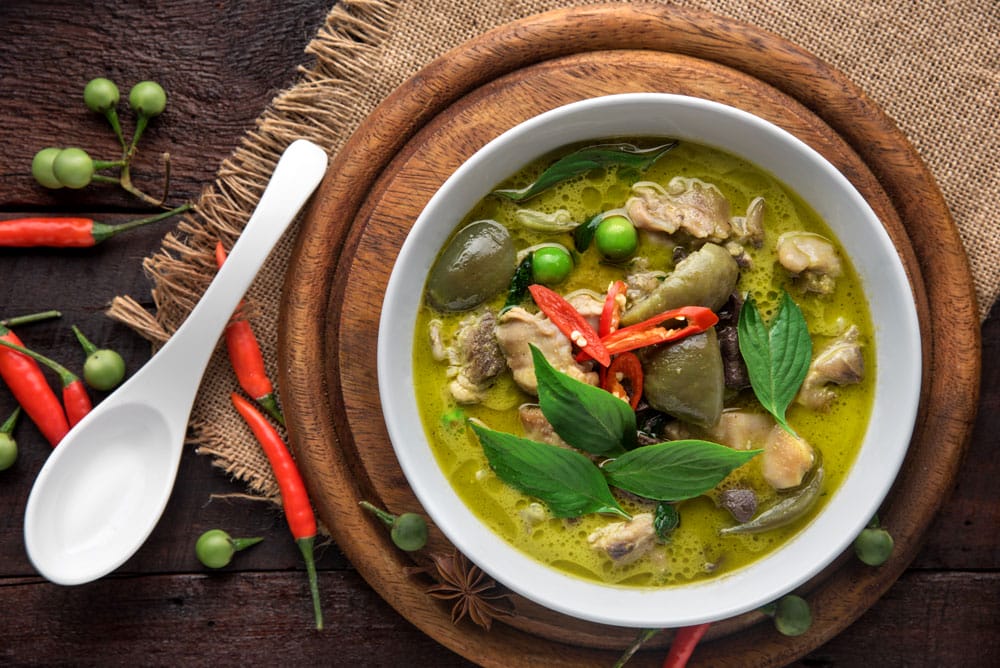
Gaeng keow wan — Thai green curry with chicken and Thai basil
04 • THE CLASSIC

GAENG KEOW WAN • แกงเขียวหวาน

Thai Green Curry

The name translates as "sweet green curry", and the sweet refers to the colour, not the taste — a warning worth heeding, because green curry is usually the hottest of the three main Thai curries. The paste is built on fresh green chillies, galangal, lemongrass, coriander root, shrimp paste and kaffir lime zest, then loosened with coconut milk until it turns pale jade.

A good one is cracked properly: the coconut cream is fried until the oil separates and beads on the surface, which is where the fragrance comes from. Into that go chicken or beef, pea aubergines that pop between your teeth, slices of soft green aubergine, bamboo shoots and a final handful of Thai sweet basil thrown in off the heat.

Eat it over rice, not as soup — Thais ladle a little onto a plate of rice at a time. Ordering it alongside something dry and salty, like an omelette or grilled pork, is how locals balance the richness.

PATTAYARimpa Lapin for the view-and-curry combination, or any of the Thai kitchens on the upper floors of Central Festival Pattaya Beach.
BANGKOKErawan Thai at CentralWorld for a refined version, or any busy curry-over-rice shop with trays out front for the honest one.
PRICE฿60–100 over rice at a shop • ฿200–350 restaurant
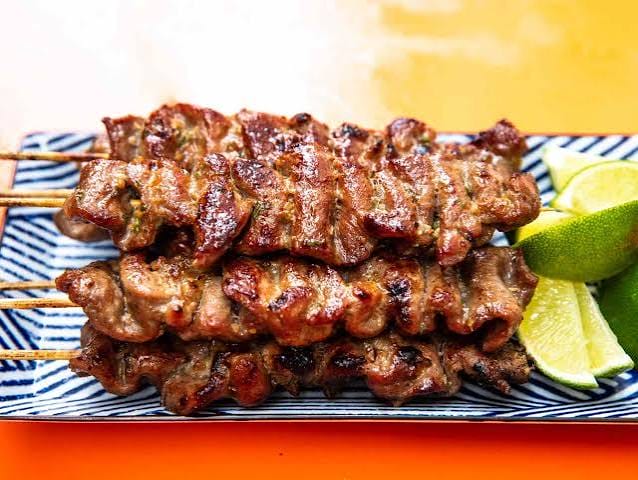
Moo ping — grilled marinated pork skewers over charcoal
05 • STREET KING

MOO PING • หมูปิ้ง

Grilled Pork Skewers

Moo ping is the smell of a Thai morning. Strips of pork — ideally with a decent ribbon of fat — are marinated overnight in garlic, white pepper, coriander root, soy, oyster sauce, palm sugar and often coconut milk, then threaded onto bamboo and fanned over charcoal. The sugar caramelises, the coconut milk brushed on at the end chars in patches, and the fat drips and flares.

The correct order is two or three skewers with a small bag of sticky rice, eaten standing up. Ten to fifteen baht a stick makes it the best-value hot food in the country, and it is genuinely good — smoky, sweet-salty, faintly floral from the coriander root.

You'll see chicken (gai ping) and beef versions at the same carts. Look for a vendor with a fast-moving queue rather than a full tray; skewers sitting under a lamp go dry and tough within twenty minutes.

PATTAYAThe charcoal carts along Jomtien Night Market, and the grill row at Thepprasit Night Market on weekend evenings.
BANGKOKJodd Fairs DanNeramit near Ha Yaek Lat Phrao, or the riverside stalls at Asiatique The Riverfront.
PRICE฿10–15 a skewer • ฿40–60 with sticky rice
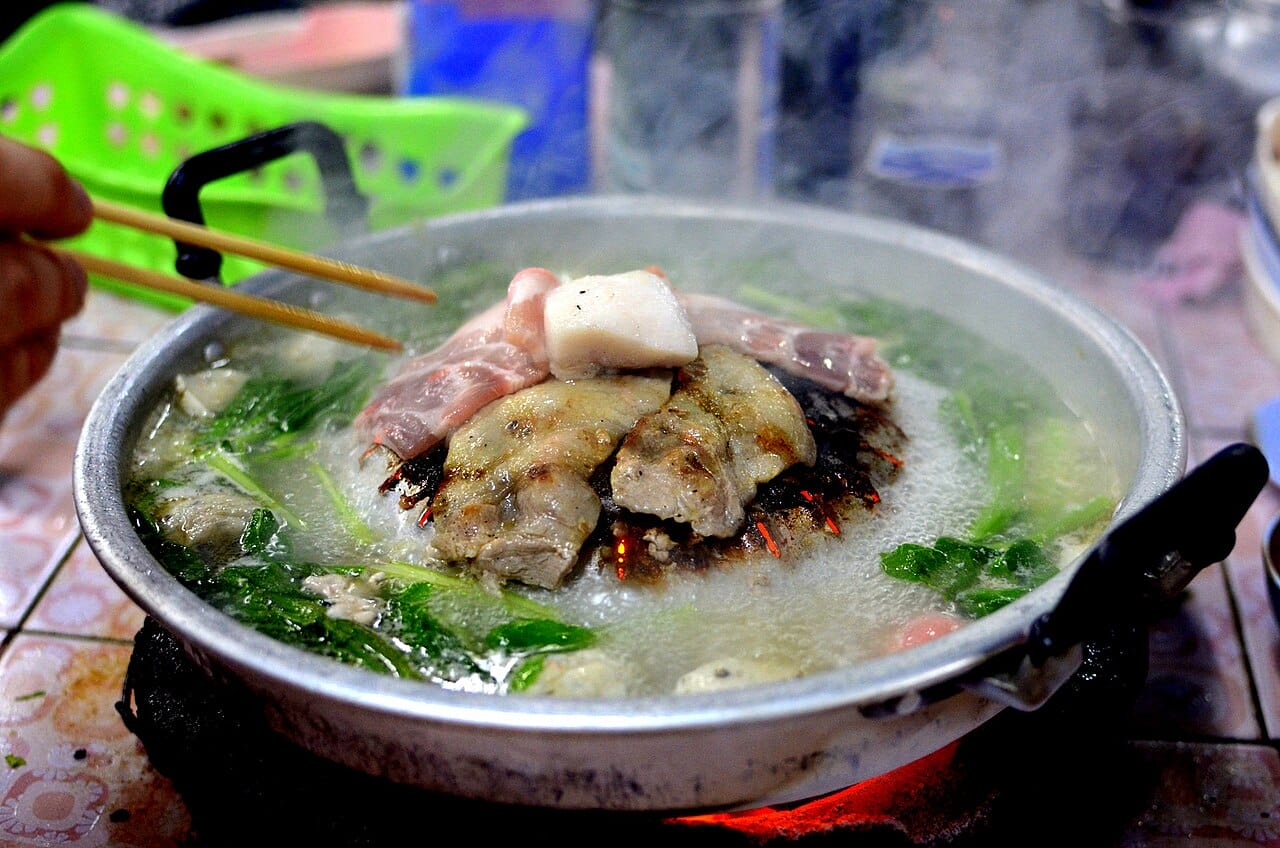
Moo gata — Thai barbecue hot pot with grill dome and surrounding broth
06 • COMMUNAL

MOO GATA • หมูกระทะ

Thai BBQ Hot Pot

Moo gata is the most fun you can have with 250 baht in Thailand. A domed metal pan sits over hot coals in the middle of your table: the raised centre is a grill, the moat around it holds a simmering pork-bone broth. You rub the dome with a cube of pork fat, slap marinated pork, beef, squid and prawns onto it, and the rendered fat runs down into the moat where your noodles, morning glory and eggs are cooking. Nothing is wasted.

It's almost always buffet — one price, unlimited trips to the raw bar, usually a two-hour limit and a small fine if you leave food uneaten. That last rule is worth respecting; take less, more often.

It is loud, smoky, sociable and inherently slow, which is exactly the point. Go with a group, order a bucket of ice and beer, and expect to still be at the table three hours later.

PATTAYAThe moo kata buffet houses off Central Pattaya Road and along Thepprasit Road in Jomtien — look for the outdoor tables and coal smoke.
BANGKOKThe buffet chains scattered through Sukhumvit's residential sois, plus grill-your-own stalls at Jodd Fairs.
PRICE฿199–329 per person buffet • ฿400+ for premium seafood tiers
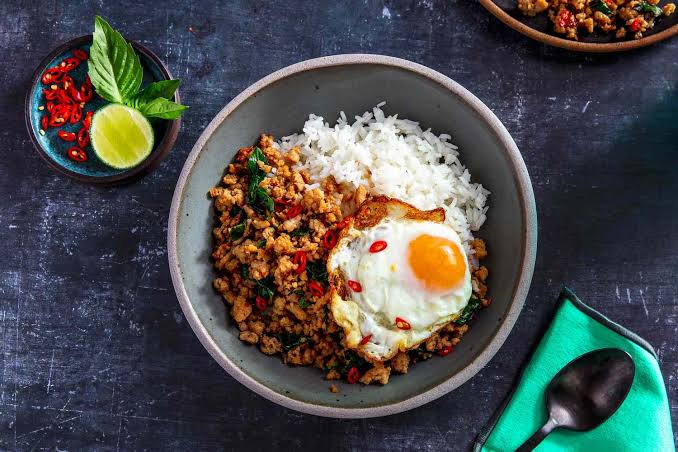
Pad grapow moo — stir-fried minced pork with holy basil over rice and a fried egg
07 • NATIONAL LUNCH

PAD GRAPOW • ผัดกะเพรา

Holy Basil Stir-Fry Over Rice

Ask a Thai person what they eat when they can't decide and the answer is pad grapow. Garlic and chillies are pounded to a rough paste, thrown into hot oil, followed by minced pork, chicken or beef, a splash of soy and oyster sauce, and a huge handful of holy basil that wilts on contact and releases a peppery, almost clove-like perfume. Served over rice with a crisp-edged fried egg on top, it takes four minutes to cook and about six to eat.

The key is grapow — holy basil — not the sweet Thai basil used in curries. Restaurants abroad substitute constantly and it's never the same; the real thing is sharper and slightly medicinal in the best way.

Order it "rad kao, kai dao" — over rice, with a fried egg. If you want the version locals eat, ask for it with crispy pork belly (moo krob) instead of mince.

PATTAYAThai Basil Tray, or any of the small rice-and-curry shops along Jomtien Second Road that cook to order.
BANGKOKThe pavement woks beneath almost any BTS station, and the casual Thai canteens tucked behind Siam Square One.
PRICE฿50–70 at a rice shop • ฿150–250 restaurant
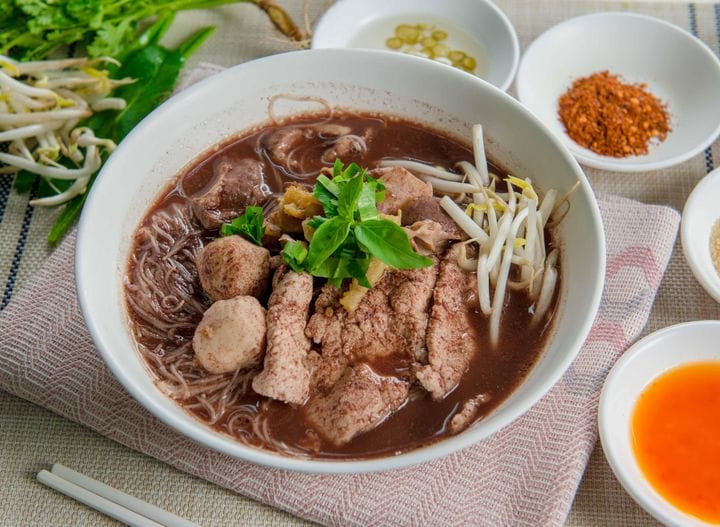
Boat noodles — small bowls of dark, rich pork noodle soup
08 • ORDER TEN

KUAY TEOW RUA • ก๋วยเตี๋ยวเรือ

Boat Noodles

Boat noodles get their name from the canal vendors who once sold them from small wooden boats — bowls were kept tiny so they wouldn't slop over as the boat rocked. The tradition stuck. Bowls arrive barely larger than a teacup, and the done thing is to stack the empties in a tower beside you and keep going until the vendor stops bringing them.

What's inside is anything but small. The broth is dark, thick and intensely savoury — pork or beef bones simmered for hours with star anise, cinnamon, galangal and dark soy, then enriched at the last moment with a spoonful of fresh pig's or cow's blood, which thickens it and adds a mineral depth. Into it go rice noodles, tender slices of meat, meatballs, morning glory and crunchy pork crackling.

Season your own bowl from the caddy on the table: chilli flakes, chilli vinegar, sugar and fish sauce. Ten bowls is a normal lunch and still costs less than a coffee.

PATTAYAThe noodle stalls at Jomtien Night Market, plus the small shophouse noodle shops dotted along Soi Buakhao.
BANGKOKBoat Noodle Alley beside Victory Monument — a whole canal-side lane of them — or the noodle row at Jodd Fairs.
PRICE฿20–25 a small bowl • ฿60–90 for a large "tourist" bowl
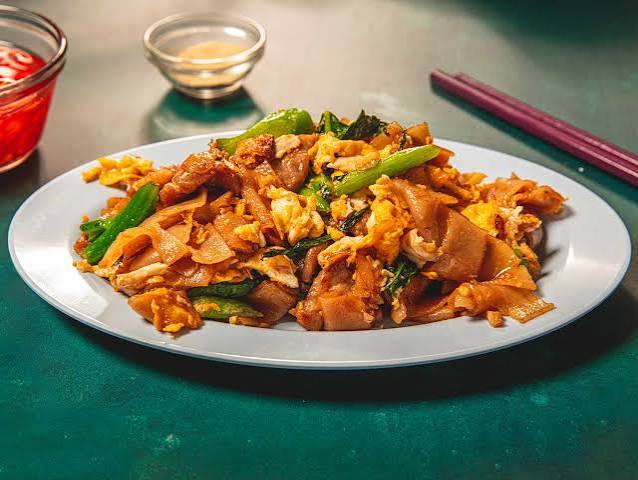
Pad see ew — wide rice noodles with Chinese broccoli and egg
09 • WOK SMOKE

PAD SEE EW • ผัดซีอิ๊ว

Soy-Fried Wide Rice Noodles

Pad thai gets the tourist attention; pad see ew gets the repeat orders. Broad, slippery fresh rice noodles are fried over a ferocious flame with dark and light soy sauce, garlic, egg, thick stems of Chinese broccoli and your choice of pork or chicken. There's no chilli in the recipe at all — it's savoury, faintly sweet and deeply comforting.

Everything depends on the wok. A good cook gets the pan hot enough that the noodles blister and pick up wok hei, that smoky char you cannot fake at home on a domestic hob. Undercooked, it's greasy and pale; done right, there are dark caramelised edges on the noodles and the gai lan stays snappy.

The condiment caddy is where you make it yours — chilli vinegar cuts the richness beautifully. If you like heat, order its rowdier sibling pad kee mao (drunken noodles) instead.

PATTAYAStreet woks along Jomtien Beach Road in the evening, or the Thai counters in the Central Festival Pattaya Beach food court.
BANGKOKAny pavement noodle wok with a queue; the Sukhumvit soi restaurants between BTS Asok and Thong Lo do reliable versions.
PRICE฿50–80 street • ฿160–250 restaurant
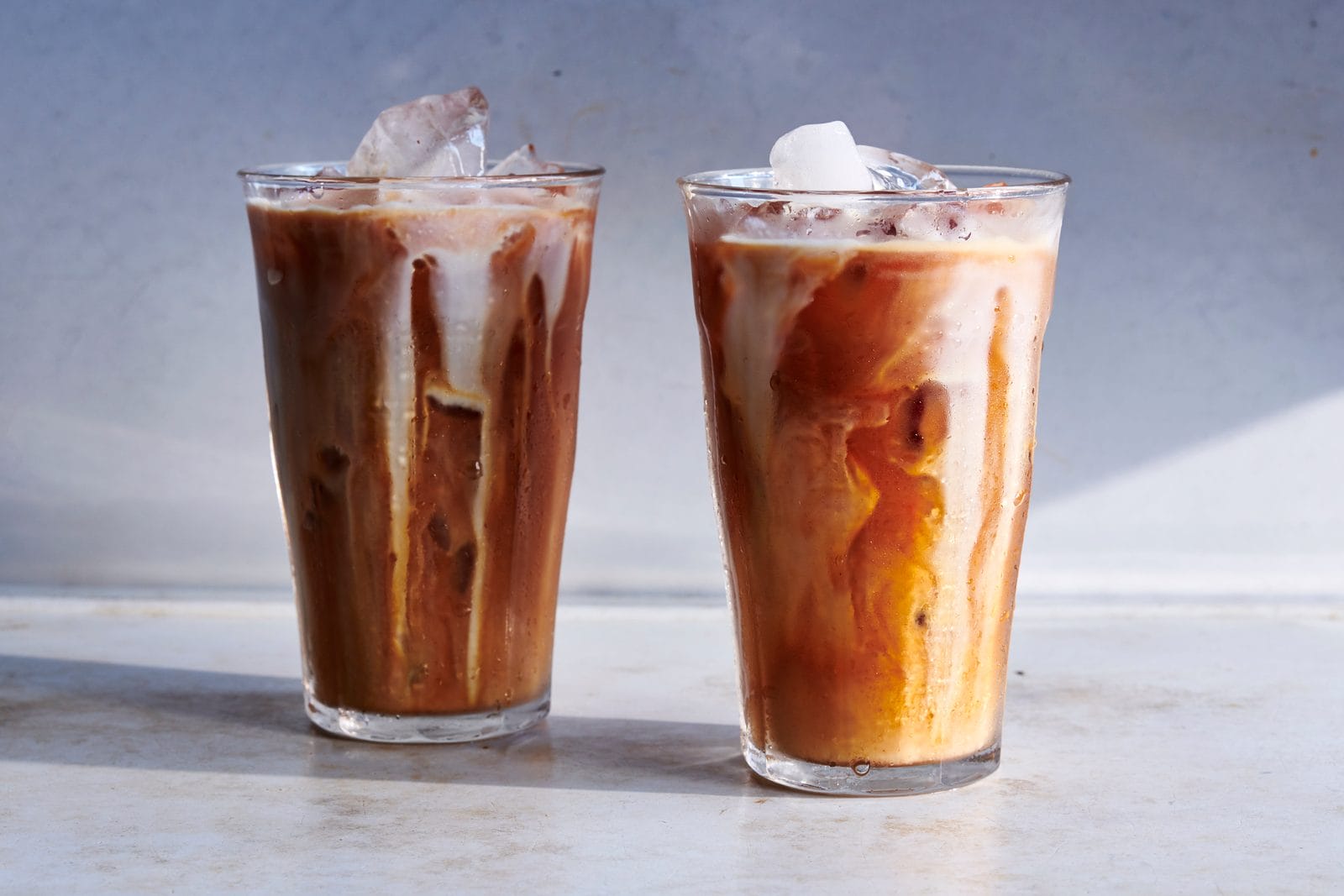
Cha yen — Thai iced tea in a plastic cup with condensed milk swirl
10 • THE DRINK

CHA YEN • ชาเย็น

Thai Iced Tea

That luminous orange drink in the plastic bag with a straw poking out is cha yen, and after an hour in Bangkok humidity you will understand why the entire country runs on it. Strong black tea is brewed with star anise, tamarind and vanilla, sweetened hard with sugar and condensed milk, then poured over crushed ice and topped with evaporated milk that sinks through in ribbons.

It is unapologetically sweet — this is dessert in a cup, not a refreshment — but the tannin and spice keep it from being cloying. Stir it before drinking so the milk layer disperses; otherwise the first inch is cream and the last is bitter tea.

Ask for "wan nit noi" (a little sweet) and most carts will halve the sugar. The unsweetened black version is cha dam yen, and the green tea one is cha keow yen.

PATTAYATea carts along Jomtien Beach Road and outside every 7-Eleven, or Café Amazon branches for an air-conditioned version.
BANGKOKStreet carts on practically every corner, plus the Cha Tra Mue (ChaThai) shops in most BTS stations and malls.
PRICE฿25–40 from a cart • ฿55–75 at a branded shop

Costing your trip

Ten of these dishes cost less than one airport dinner

Eat like this and food becomes the cheapest part of your holiday — but only if the rest of the budget is honest too. ThaiHolidayBudget lets you build a realistic daily total for Pattaya, Bangkok or anywhere else in the kingdom: accommodation, transport, food, drinks and activities, with 2026 prices rather than blog-post guesses from 2015.

Plan your Thailand budget →
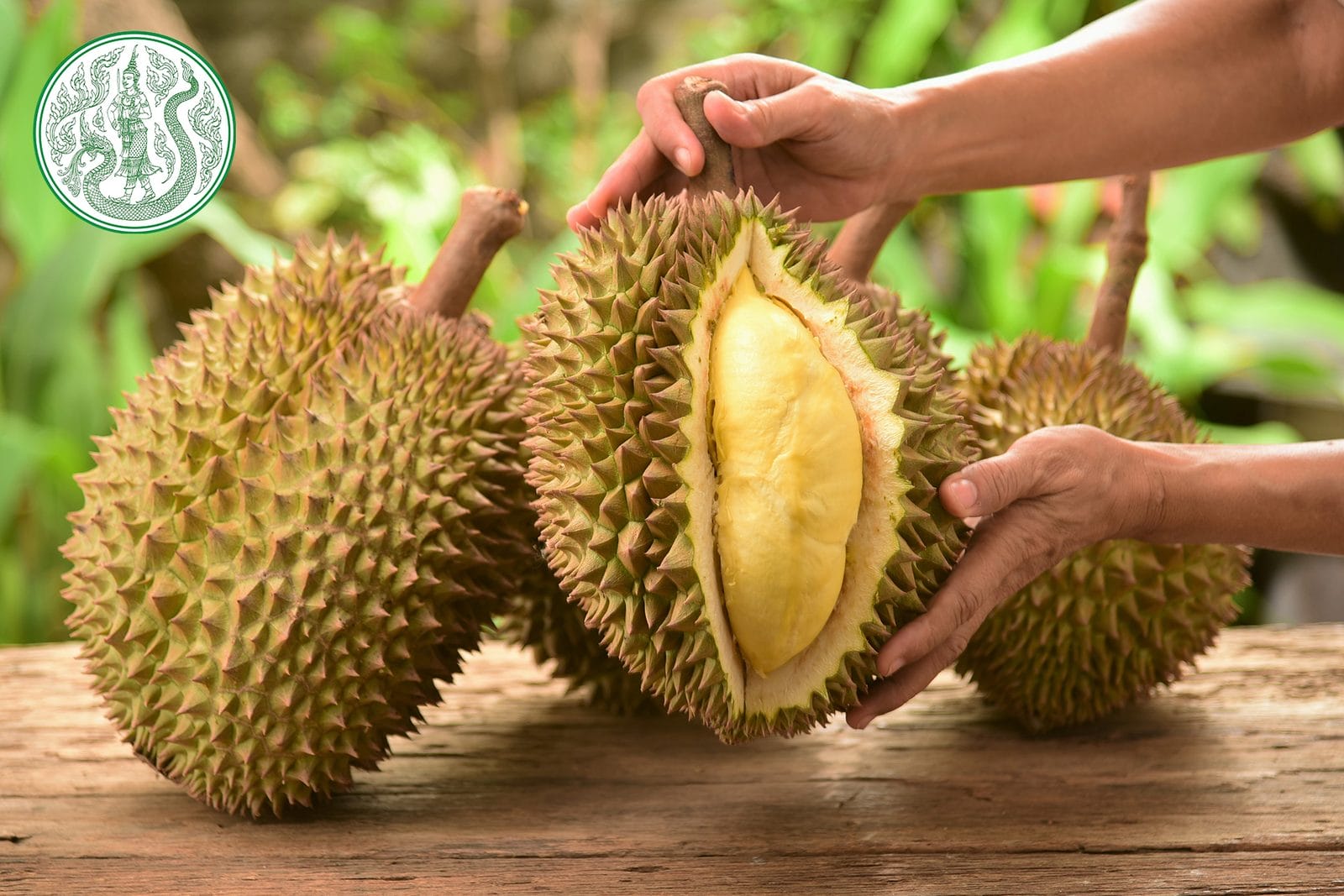
Durian — the spiky king of fruits opened to show yellow flesh
11 • THE DARE

DURIAN • ทุเรียน

The King of Fruits

No fruit divides people like durian. The smell — banned on the BTS, in most hotels and on every airline — arrives before the fruit does: something between caramelised onion, gas and overripe custard. Get past it and the flesh is extraordinary: dense, buttery, almond-sweet and faintly savoury, closer to a rich cheesecake than anything else in the fruit aisle.

Variety matters enormously. Monthong is the mild, creamy, beginner-friendly one and the best place to start. Kan Yao is sweeter and pricier. Chanee is stronger and more pungent. Season runs roughly April to August, which is when prices drop and quality peaks.

If you're hesitant, ease in via khao niao thurian — durian with coconut sticky rice — or a durian smoothie, both of which soften the intensity considerably. Buy a pre-packed tray rather than a whole fruit; a single durian is a serious commitment.

PATTAYAFruit stalls at Jomtien Night Market and the Thepprasit fruit rows during season (April–August).
BANGKOKThe fruit section of Chatuchak Weekend Market, or dedicated durian shops around Yaowarat and Or Tor Kor Market.
PRICE฿150–400 per kg for Monthong • ฿80–120 a tray • ฿120–180 with sticky rice
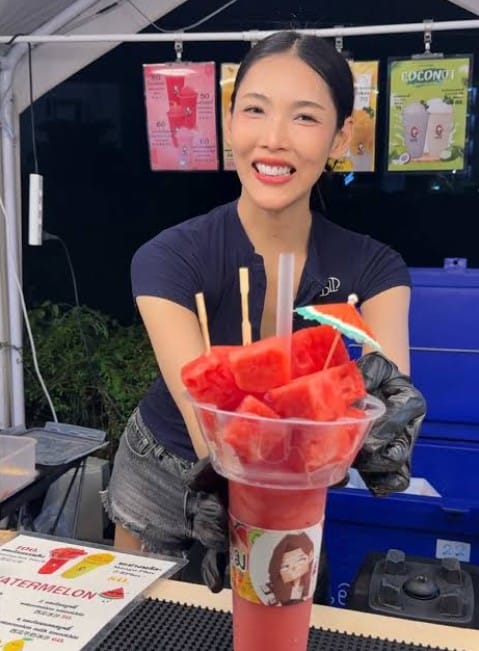
Watermelon smoothie blended fresh at a Thai fruit stall
12 • HEAT RELIEF

TAENG MO PAN • แตงโมปั่น

Watermelon Smoothie

There is no better answer to 35°C and 80% humidity than a watermelon shake made in front of you. Thai fruit carts blend fresh chunks with ice and nothing else if you ask — no syrup, no water, no milk — producing something halfway between a juice and a sorbet, faintly foamy on top and cold enough to hurt.

Watermelon is the classic because it's cheap, always in season and hydrating, but the same cart will do mango, passionfruit, pineapple, lychee and coconut. The two combinations worth going out of your way for are coconut-mango, which drinks like a dessert, and strawberry-pineapple, which is sharp and bracing.

One warning: many vendors add sugar syrup by default. Say "mai sai nam tan" (no sugar) and you'll get the fruit as it actually tastes, which with good Thai watermelon is sweet enough already.

PATTAYAThe juice stalls at Jomtien Night Market and the fruit carts strung along Jomtien Beach Road.
BANGKOKBlender carts throughout Asiatique The Riverfront and Jodd Fairs, and outside almost every BTS exit.
PRICE฿30–50 from a cart • ฿80–120 in a mall or café
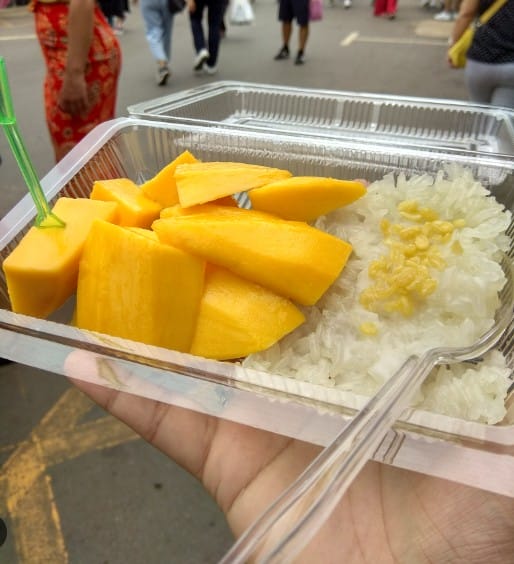
Mango sticky rice with coconut cream and toasted mung beans
13 • THE DESSERT

KHAO NIAO MAMUANG • ข้าวเหนียวมะม่วง

Mango Sticky Rice

Thailand's most famous dessert is also its simplest: glutinous rice steamed then folded through warm, salted coconut cream until each grain is glossy, served beside half a ripe nam dok mai mango with a little extra cream poured over and a scatter of toasted mung beans or sesame on top.

The salt is the trick everyone misses. Without it the whole plate is sugar; with it the coconut turns savoury against the mango's perfume and the dish becomes something you think about weeks later. Temperature matters too — the rice should be warm and the mango cool.

Peak mango season is roughly March to June, when the fruit is at its most fragrant and cheapest, but good vendors serve it year-round. If the mango looks pale and firm rather than deep gold and yielding, walk on and find another stall — the rice is easy, the fruit is what separates the great from the ordinary.

PATTAYADessert stalls at Jomtien Night Market, and the fruit-and-sweets vendors at Thepprasit Night Market.
BANGKOKVendors throughout Asiatique The Riverfront and Chatuchak Weekend Market; also every decent dessert counter in Siam.
PRICE฿60–100 at a stall • ฿150–250 in a café
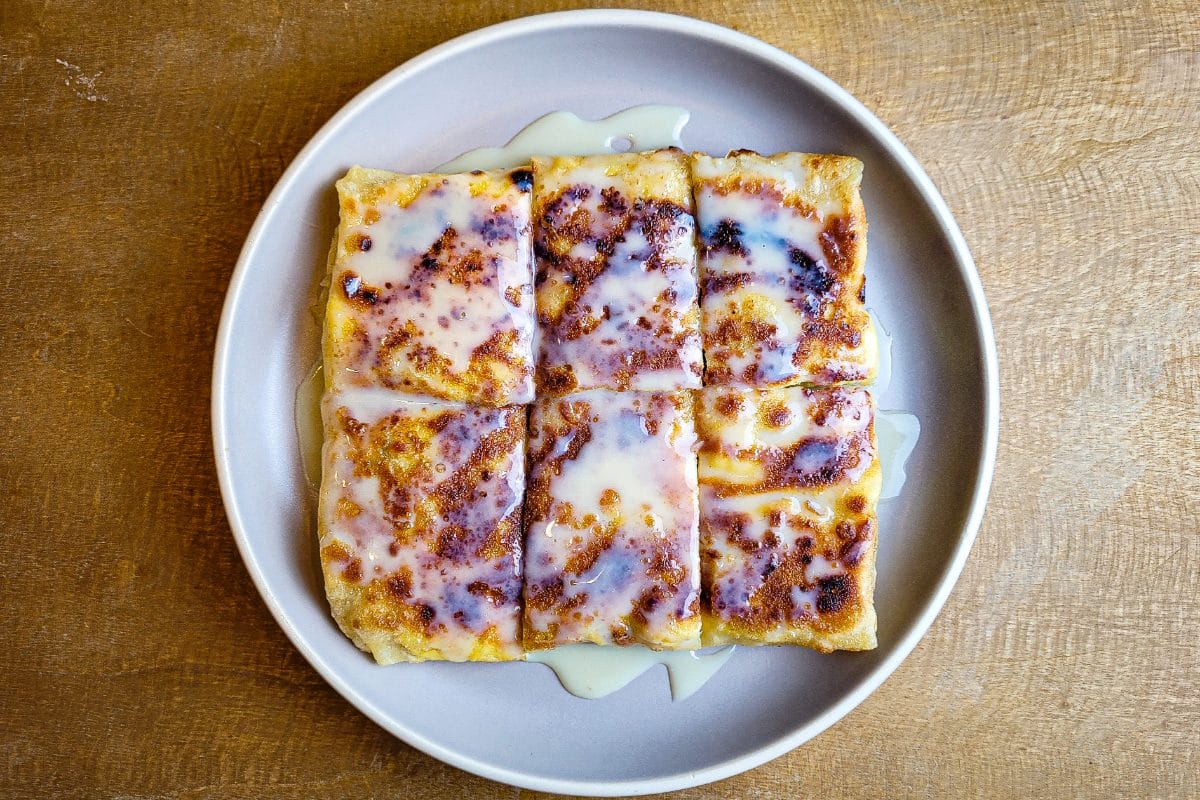
Roti gluay — crispy banana pancake drizzled with condensed milk and chocolate
14 • LATE NIGHT

ROTI GLUAY • โรตีกล้วย

Crispy Banana Pancake

Watching roti being made is half the reason to order one. The vendor slaps a ball of oiled dough onto a steel griddle, flings it out until it's almost transparent, scatters sliced banana and cracks an egg into the middle, then folds the edges into a neat parcel and fries it in margarine until the outside shatters like pastry.

It's cut into squares, drizzled with condensed milk and chocolate sauce, dusted with sugar and handed over in a paper sleeve. Crisp, buttery, custardy in the centre from the egg — it is one of Thailand's great post-midnight foods and has almost nothing to do with traditional Thai cooking, having arrived with South Asian and Muslim traders generations ago.

Variations run to Nutella, strawberry, egg-only or plain with sugar. Ask for less condensed milk unless you have a serious sweet tooth; vendors are generous to the point of recklessness.

PATTAYAThe griddle carts at Jomtien Night Market and Thepprasit Night Market, usually running until late.
BANGKOKRoti vendors at Chatuchak Weekend Market and Asiatique, plus the Khao San Road carts if you're in the area.
PRICE฿40–60 with banana and condensed milk • ฿70–90 with extras
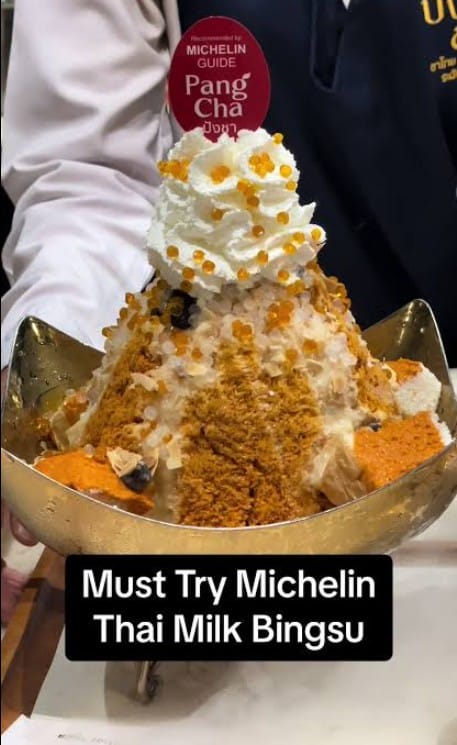
Nam kang sai — Thai shaved ice piled with syrups and toppings
15 • MOUNTAIN OF ICE

NAM KANG SAI • น้ำแข็งไส

Thai Shaved Ice

Nam kang sai is what Thailand did with shaved ice long before anyone called it a trend. In its street form it's a bowl of finely shaved ice built over a chosen pile of toppings — red water chestnuts, jackfruit strips, palm seeds, grass jelly, sweetcorn, red beans, taro — then drenched in coloured syrup and evaporated milk. Cheap, cold, faintly chaotic, and exactly right at 3pm.

The café version is a different animal. Thai tea is frozen and shaved into fine snow that collapses the moment your spoon touches it, then built into a small mountain and topped with cream, tea jelly and syrup. It's the most photographed dessert in Bangkok for good reason: it tastes strongly of proper cha yen rather than of sugar.

Either way, eat it fast. A shaved-ice dessert has a working life of about eight minutes in Thai heat before it becomes a bowl of sweet soup.

PATTAYAAfter You Dessert Café at Terminal 21 Pattaya for the polished version; the market stalls at Jomtien for the traditional one.
BANGKOKPang Cha Thai Royal at ICONSIAM — widely rated the best shaved Thai tea ice in the country, and worth the trip across the river.
PRICE฿60–120 at a market stall • ฿180–280 at a dessert café
Bubble tea with tapioca pearls and a wide straw
16 • THE OBSESSION

BOBA • ชานมไข่มุก

Bubble Tea

Boba isn't Thai — it came from Taiwan — but Thailand has adopted it with an enthusiasm bordering on national obsession. Every mall, every market and most petrol stations now have at least one counter sealing cups of milk tea over a bed of warm, chewy tapioca pearls.

The pearls are the point. Properly made, they're springy with a slight bite in the centre and steeped in brown sugar syrup so they're sweet on their own; badly made, they're gluey or hard. A shop with high turnover almost always has better pearls, because tapioca goes stale within hours.

The version worth trying here is Thai milk tea boba, which swaps the standard black tea for the spiced orange cha yen blend. Most chains let you set sweetness and ice levels — 50% sugar is plenty for most palates and closer to how the tea was meant to taste.

PATTAYAMixue branches all over the city — cheap and everywhere — plus Cha Doi for a slightly more serious cup.
BANGKOKMixue and Cha Doi again, with Café Amazon branches in nearly every BTS station and petrol forecourt.
PRICE฿25–45 at Mixue • ฿60–120 at premium chains
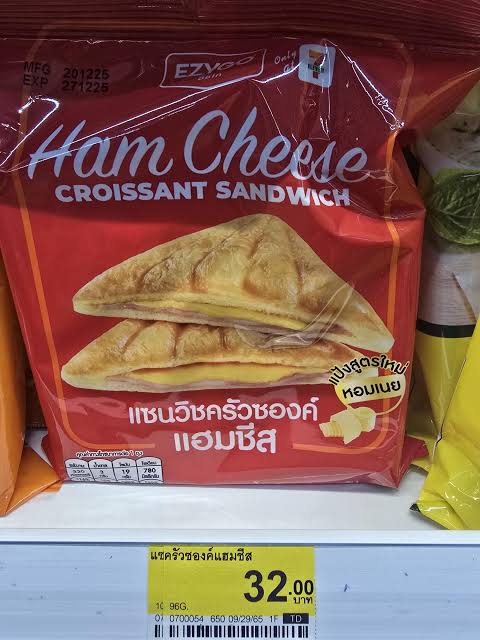
7-Eleven ham and cheese toasty, golden and pressed
HONORARY MENTION

7-ELEVEN TOASTY • แซนด์วิชปิ้ง

Ham and Cheese Toasty

The 7-Eleven Ham and Cheese Toasty is Thailand's unofficial national snack. A thin slice of vaguely ham-flavoured meat and a pale square of processed cheese get pressed between two slices of soft white bread, then blasted in a toaster until the outside is golden and the inside turns into warm, slightly greasy comfort.

Fans treat it like medicine. Hungover backpackers, night-shift workers, and 3 a.m. wanderers swear by its ability to fix almost anything. It is cheap, always available, and sells in absurd volumes across thousands of stores. Many nights the shelf is empty before midnight.

Critics are less kind. They call it dry, bland, and suspiciously rubbery. The cheese barely melts. The ham has the personality of a damp napkin. One review simply labelled it "cardboard with commitment issues."

Yet the toasty keeps winning. Love it or mock it, almost everyone still buys it. Because when you're tired, tipsy, or just hungry in Thailand, nothing else hits quite the same.

PATTAYAAny 7-Eleven — there's one on practically every corner. Hand it over the counter and they'll toast it for you.
BANGKOKSame story — 7-Eleven branches on nearly every street, BTS station and soi across the city.
PRICE฿32–35 at 7-Eleven • toasted free on request

Before you go

How to eat well here without overthinking it

Three rules cover almost everything. Eat where Thai people are eating. Eat where the food is moving. And when a vendor only sells one thing, order that thing.

🔥

Manage the heat

Mai pet means not spicy, pet nit noi means a little spicy. Thai "a little" is most people's "quite a lot", so start low. Plain rice, not water, is what actually puts the fire out.

🧊

Ice is fine

Commercial ice in Thailand is made from filtered water at licensed plants — the tube-shaped ice with a hole through it is the giveaway. Street drinks are not the thing that will make you ill.

💸

Carry small notes

A cart selling 15-baht skewers cannot break a thousand. Keep 20s, 50s and 100s, or use the QR PromptPay scanners now taped to most stalls — even the tiny ones take them.

Work through all sixteen and you'll have spent perhaps 1,500 baht — under £35 — for a fair summary of one of the world's great cuisines. Cost the rest of your trip just as honestly at ThaiHolidayBudget.

ThaiThuk

Written by

Genext Information Systems Staff

ThaiThuk's editorial team at Genext Information Systems — writers and long-term residents based in Thailand who report from the ground on Thai culture, travel, food and community. Every piece is checked against primary sources and updated as details change. More about ThaiThuk →