
ThaiThuk topic hub
Thai food
What the dishes actually are, which region they come from, and where to find a good version.
"Thai food" is a national label over at least four distinct regional cuisines, and the gap between them is wider than most menus abroad suggest. Central Thai cooking is the one that travelled; Isan cooking from the northeast is the one most Thais actually eat every day, and it is sour, salt-forward and built around sticky rice rather than jasmine.
This hub is organised the way you are likely to be thinking: start from the dish if you want to know what to order, start from the region if you want to understand why one som tam tastes nothing like the last one, and start from the city guides if you already know what you want and need an address.
Hub last reviewed by the ThaiThuk desk. Individual pages carry their own published and updated dates.
How a Thai meal is actually built
The most useful thing to understand about Thai food is structural, not culinary: outside of single-plate street dishes, a Thai meal is not a starter and a main. It is a group of dishes placed in the middle of the table, eaten together with rice, and deliberately chosen to balance one another.
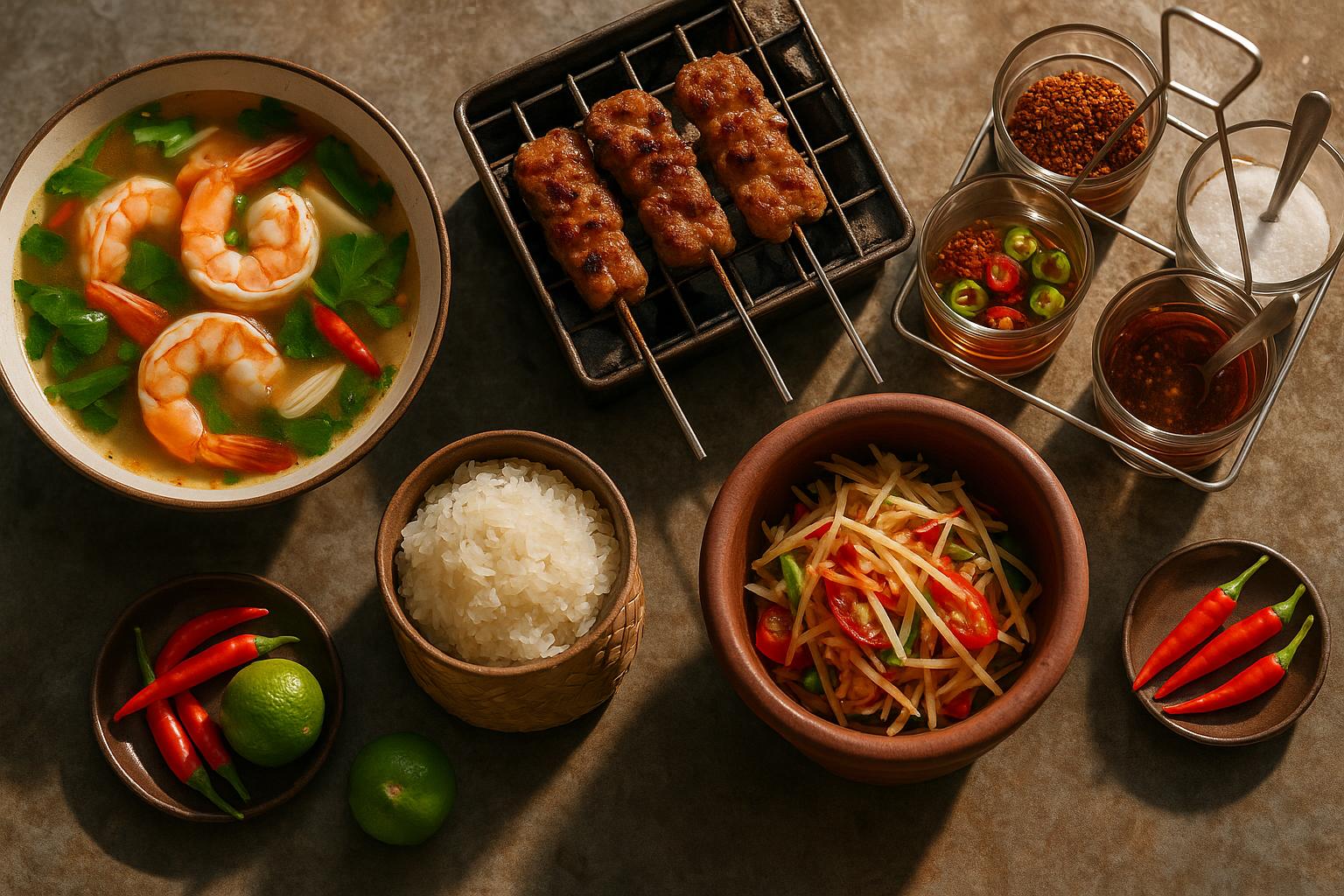
A well-composed table has something sour and hot (a soup such as tom yum), something salty and rich (a curry or a stir-fry), something fresh and sharp (a salad — a yam or a som tam), and something plain to carry it (rice, always). Ordering four curries for four people is the classic visitor mistake: it is not a worse meal because the curries are bad, it is a worse meal because nothing on the table relieves anything else.
Rice is the meal and everything else is, grammatically, what goes with it — the phrase kap khao means roughly 'with rice'. This is why portions of the shared dishes look small: they are not your dinner, they are the seasoning for it.
The four flavours everyone quotes — hot, sour, salty, sweet — are best understood as adjustable rather than fixed. That is what the condiment caddy on the table is for: dried chilli, chilli in vinegar, fish sauce with chilli, and sugar. A Thai diner seasons the dish in front of them. You are expected to as well, and using it is a compliment, not a correction.
Ordering: the handful of words that change everything
You do not need Thai to eat well here, but four or five phrases will transform what arrives.
Spice. Phet nit noi — a little spicy. Mai phet — not spicy. Be aware that a stall's idea of 'a little' is calibrated to local tolerance, and that some dishes, particularly som tam and the Isan salads, are built on chilli rather than seasoned with it. Asking for a non-spicy som tam is asking for a different dish.
Fish sauce and shrimp paste are in a great deal more than you would guess, including many vegetable dishes. Vegetarians should learn mangsawirat (vegetarian) and, more reliably, look for the yellow and red jay signage, which indicates strict vegan Buddhist cooking.
Rice. Khao suay is plain steamed rice; khao niao is the sticky rice eaten by hand in the north and northeast, and it is the correct partner for grilled meat and som tam.
The bill. Kep tang — collect the money. Tipping is not obligatory at street level; rounding up is normal and generous.
Where to eat, and roughly what it costs
Price tracks setting far more than it tracks quality. The same dish can vary fivefold across a few hundred metres, and the cheap version is very often the better one.
| Where | Typical single dish | What you get |
|---|---|---|
| Street cart / market stall | 40–60 baht | One thing, made hundreds of times a day. Usually the best version in the neighbourhood. |
| Shophouse restaurant | 60–120 baht | A proper menu, fans or air-con, shared dishes and rice |
| Mall food court | 50–90 baht | Card or coupon system, clean, air-conditioned, safe and unromantic |
| Night market | 40–100 baht | Grazing rather than a meal; grilled meat, snacks, desserts |
| Tourist-strip restaurant | 200–400 baht | English menus, sanded-down spice, the same dish for several times the price |
Four kitchens, one country
'Thai food' as it is understood abroad is mostly central Thai food, and it is roughly a quarter of the story.
Central cooking is the sweetest and the most coconut-rich — the green and red curries, the dishes that travelled internationally. Isan, the northeast, is the country's most influential regional kitchen and the one you meet most often on the street: grilled meat, sticky rice, som tam, larb, fermented fish, chilli and lime doing the work that coconut does further south.
Northern food around Chiang Mai is milder, earthier and more herbal, with pork, dill and bitter greens, and its own noodle dishes. Southern food is the hottest in the country by some distance, heavy on turmeric, shrimp paste and fresh seafood — if you believe you have a high chilli tolerance, the south is where that belief gets tested.
Ordering across regions rather than within one is the fastest way to eat well: an Isan grill, a central curry, a plate of northern greens.
Start from the dish
Sixteen dishes with what each one tastes like and what it should cost, rather than a ranked list.
-
Sixteen Thai dishes to try, and where to eat them
Tom yum goong, moo ping, boat noodles, mango sticky rice and twelve more — flavour notes, where to find each in Pattaya and Bangkok, and expected prices.
Start from the region
Isan — the northeast, sometimes spelled Esan — is the regional cuisine most worth understanding as its own thing.
-
The soul of Isan: ten essential dishes of the northeast
Grilled pork neck, laab, som tam pla ra, jim jum and more — the boldest and most communal cooking in Thailand.
-
The culture the food comes out of
Family life, sticky rice and community in Thailand's northeast — context for why Isan eating works the way it does.
Start from the city
Where the stalls cluster, with directions.
-
Bangkok food streets, area by area
Sixteen streets and sois where the stalls genuinely cluster, each with directions from the nearest station or pier.
Elsewhere on ThaiThuk
- Thai culture — Festivals, hospitality and Isan life.
- Bangkok — The rest of our capital coverage.
- Thailand travel — Seasons and budgets.