Sports tourism
A weekend built around fighting
By Genext Information Systems Staff
Published 26 July 2026 • 7 min read
For a city that spends most of the year being written about for its bars, Pattaya had an unusually athletic weekend. On Friday 24 July, a former two-time world heavyweight champion fought in a Muay Thai stadium off Thepprasit Road in front of roughly 1,500 people and no television cameras. Twenty-four hours later, the city's own tourism office had a full-size boxing ring erected on the sand at Central Pattaya Beach and gave away every seat for free.
The two events could hardly have been more different in scale, budget or intent. One was a British boxing operation using Thailand as a convenient staging post. The other was a municipal culture-and-tourism project dressed up as a fight card. But held back to back, they told the same story — a city, and increasingly a country, that has decided combat sport is one of the few things it can still sell to the world at a moment when its visitor numbers are drifting the wrong way.
The heavyweight who came to Thepprasit
Tyson Fury's comeback tune-up happened in Pattaya — and almost nobody saw it live.
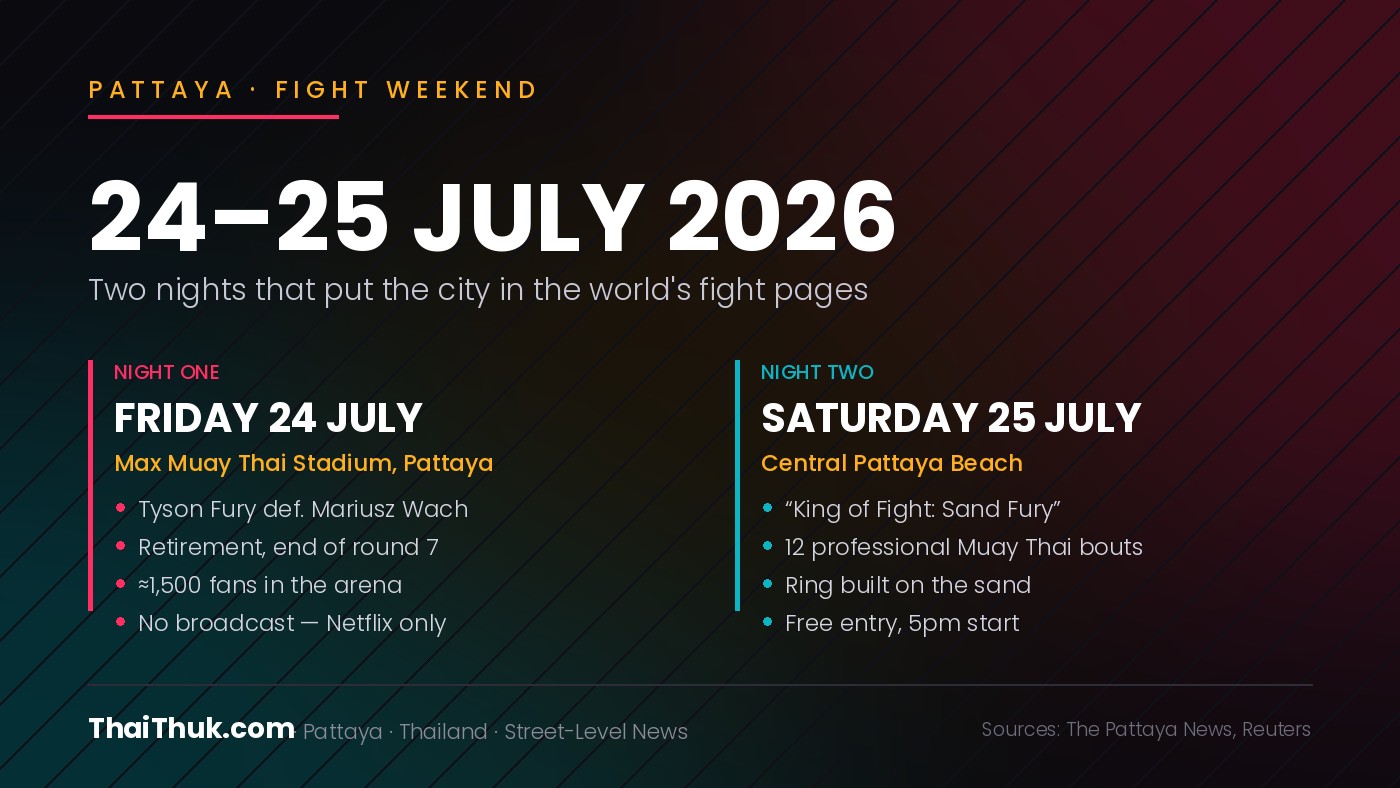
Tyson Fury, the Manchester heavyweight who beat Wladimir Klitschko in 2015 and fought Deontay Wilder three times, returned to the ring at Max Muay Thai Stadium in Pattaya against Poland's Mariusz Wach. It was scheduled for ten rounds. It did not get there: Wach, 46 years old and beaten in seven of his previous ten bouts, was retired by his corner before the eighth. Fury moved his professional record to 36 wins, the two defeats on it both belonging to Oleksandr Usyk in 2024.
What made the night strange was not the result — nobody in the building expected a competitive fight — but the presentation. There was no broadcaster. No pay-per-view, no streaming deal, no live feed at all. Around 1,500 people were in the arena, and beyond those 1,500 the fight simply did not exist in real time. Footage is instead being held back for the next series of the Fury family's Netflix show. In an era when even four-round club shows get pushed onto a streaming platform, a former world champion fighting in near-total broadcast darkness was genuinely unusual.
The commercial logic is clearer than it first looks. Fury has a proposed showdown with Anthony Joshua on the horizon later this year, and a tune-up fight against a durable veteran is a standard way to shake off ring rust without risking the big payday. Doing it 9,000 kilometres from the British press, in a venue that seats a fraction of an arena crowd, keeps the risk — and the noise — low.
For Pattaya, though, the calculation ran the other way. The city got its name into Reuters copy, onto Al Jazeera's sports pages and into every boxing outlet in Britain, and it will get a second pass when the Netflix episodes land. Organisers also directed ticket proceeds to local charities, with the winner taking an inaugural WBC Humanitarian belt — a detail that neatly reframed a low-stakes tune-up as something the city could be seen to benefit from.
The numbers
- 7 — rounds completed before Wach's corner pulled him out
- ≈1,500 — spectators at Max Muay Thai Stadium
- 12 — professional bouts on the beach card the next night
- 0 baht — cost of entry to the beach event
Sand Fury: a ring on Central Pattaya Beach
The city's own answer, staged where the tourists already are.
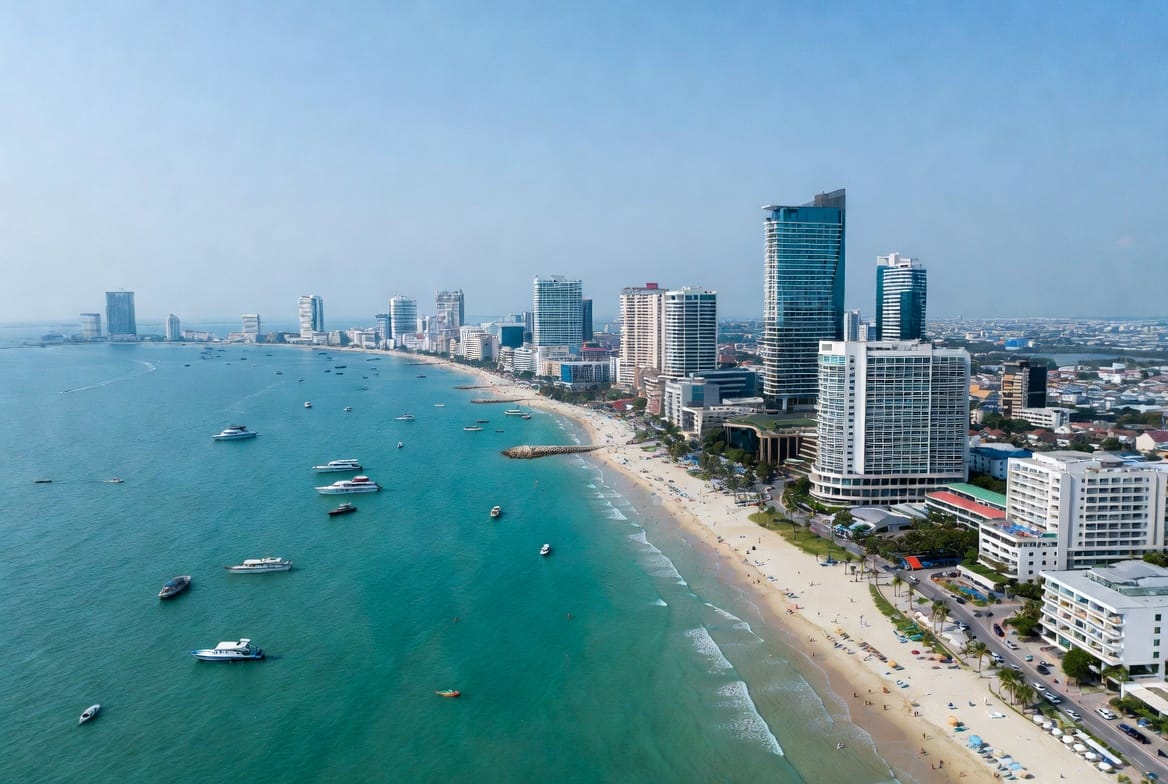
The following evening, Pattaya City, the Chonburi Provincial Sports Association and the Sports and Recreation Promotion Club turned a stretch of Central Pattaya Beach into an open-air arena for a tournament called King of Fight: Sand Fury by Pattaya. The ring went up on the sand itself, flanked by large LED screens, with seating areas, an athletes' zone and a media pen arranged around it. Doors — such as they were — opened at 5pm, and admission cost nothing.
The card ran to twelve professional bouts, headlined by Sudsakon S. Klinmee against Diego Bracero and the veteran Saiyok Pumphanmuang against Raven Hunt. The matchmaking was deliberately international: Thai fighters from Sudsakon, Srisya and Baan Ram Ba camps were paired against opponents from Europe, North America and North Africa, which is a fair reflection of where professional Muay Thai's talent pool now sits.
Around the ring, organisers ran an exhibition and market zone — food stalls representing all four Thai regions, equipment and kit displays, souvenir booths. That, more than the fights, was the point. A free beach card with a market attached is not a boxing promotion; it is a tourism activation that happens to have fighting in the middle of it.
The opening ceremony was presided over jointly by Samrit Phongwirat, Secretary-General of the Chonburi Provincial Sports Association, and Damrongkiat Pinijkarn, Deputy Mayor of Pattaya City, with the director of the Tourism Authority of Thailand's Pattaya office, the Pattaya City Police superintendent, tourist police and provincial council members among those attending. Samrit described Muay Thai as a refined art and science
embodying Thai wisdom, discipline and courage, and framed the tournament as a step towards establishing the sport as one of Thailand's core soft-power assets while drawing both Thai and international visitors to the city.
Why soft power, and why now
"Soft power" has become one of the most-used phrases in Thai public life, and it is worth being honest about why. Thailand's 2026 tourism year has been steady rather than spectacular. Roughly 16.2 million foreign visitors arrived between 1 January and early July, generating in the region of 780 billion baht — a large number by any measure, but one that sits a little over three percent below the same period last year. Weekly arrivals have been holding up on the back of Chinese and European school holidays, and the Tourism Authority of Thailand has spent the year pushing a value-led strategy that prioritises what visitors spend over how many of them come through the airport.
That strategy needs products, and Muay Thai is one of the very few Thai exports that already has a global audience, a professional circuit, a gym network that brings foreigners to the country for weeks at a time, and genuine cultural depth behind it. A visitor who comes to train for a month in Chonburi or Phuket spends more, stays longer and travels in low season more readily than one who comes for a four-night beach break. That is precisely the customer the value-led pitch is aimed at.
The beach event also solves a specific Pattaya problem. The city's international image has been fixed for decades around nightlife, and municipal efforts to broaden it — sporting events, festivals, family attractions, the Eastern Economic Corridor's business travellers — have had mixed success. A free Muay Thai card on the main beach, with regional food stalls and the tourist police visible, is a low-cost way of putting a different set of photographs into circulation. The same week, incidentally, the Chonburi governor was chairing meetings on fire safety and licensing at Banglamung entertainment venues; the two stories are not unrelated, and both point at a city trying to manage how it is seen.
Seeing Muay Thai in Pattaya
Beach cards like Sand Fury are one-offs, but Pattaya has a working fight scene most nights of the week. Max Muay Thai Stadium on Thepprasit — the venue that hosted Fury — runs regular cards aimed squarely at visitors, with English commentary and a mix of Thai and foreign fighters. Smaller stadiums and gym shows around Soi Buakhao and Nongprue offer a rougher, cheaper and often better night of fighting, and dozens of gyms across Banglamung will take a complete beginner for a single session.
Two things are worth knowing before you go. First, the ritual matters: the wai kru ram muay performed before each bout is a formal act of respect to teachers and family, not a warm-up, and audiences are expected to watch it rather than talk through it. Second, be careful about betting. The shouting and hand signals around the ring at a Thai stadium are part of the experience to watch, but gambling is illegal in Thailand and tourists who join in are the ones who get into trouble.
Ticket prices vary enormously depending on where you buy. Walking up to the stadium box office is almost always cheaper than buying through a hotel desk or a beach-road tout, and the seats sold at a premium are frequently the same ones on sale for a third of the price at the door.
What the weekend was actually about
Neither fight night, taken alone, changes very much. Fury versus Wach was a formality that will be remembered as a footnote to a much bigger fight later in the year. Sand Fury was a free municipal event that will be forgotten by everyone who did not attend it, save for the photographs.
Together, though, they are a reasonable snapshot of where Thai sports tourism is heading. One imported spectacle, bought in and hosted, generating international coverage the city could never afford to purchase outright. One home-grown cultural product, given away free on the beach, aimed at persuading people already in Pattaya that there is more to the place than Walking Street. Both were staged within a kilometre of each other, in the same week, by a city that has clearly decided the ring is a better shop window than the bar.
Whether that shifts arrival numbers is another question, and one that will not be answered by a single weekend in July. But it is a more interesting pitch than Pattaya has made in a long time.
Plan it before you book it
A Pattaya fight-and-beach trip, costed honestly
Stadium tickets, gym sessions, songthaew fares and the hotel you actually want to stay in add up faster than most people plan for. ThaiBudgetPlanner prices a Pattaya trip on 2026 numbers, and ThaiTripPlanner will build the days around it.
Price out your Pattaya trip →
Written by
Genext Information Systems Staff
ThaiThuk's editorial team at Genext Information Systems — writers and long-term residents based in Thailand who report from the ground on Thai culture, travel, food and community. Every piece is checked against primary sources and updated as details change. More about ThaiThuk →
Sources
- The Pattaya News — event announcement and post-event report on King of Fight: Sand Fury by Pattaya, 19 and 26 July 2026.
- Reuters / Al Jazeera — report on the Fury–Wach bout at Max Muay Thai Stadium, 24 July 2026.
- Tourism and Sports Ministry / Tourism Authority of Thailand — 2026 arrivals and revenue figures to early July.