Huai Yai, Banglamung, Chonburi
A billion-baht escape route ends outside Pattaya
By Genext Information Systems Staff
Published 22 September 2026 • 6 min read
The latest Pattaya news out of Chonburi province is not a street brawl or a hotel break-in. It is the end of a three-year run for a wanted man who thought a quiet housing estate outside the city was far enough from home. On Saturday 19 September 2026, officers from Thailand’s Central Investigation Bureau (CIB) moved on a property in Huai Yai, in the Banglamung district that wraps around Pattaya, and detained a 31-year-old Chinese national identified only as Mr. Yu. Investigators say he built and ran PAOFENG, a payment network accused of laundering close to one billion baht for illegal overseas gambling websites.
It is the kind of Pattaya news story that rarely makes the postcards: no beach, no bar strip, no nightlife. Just a housing estate, a police convoy, and a man who admitted, once questioned, that he was exactly who Chinese authorities said he was.
What police say happened in Huai Yai
CIB officers had been tracking Yu for some time before Saturday’s raid. His Thai residence permission had already been revoked, which meant that even before the arrest he had no legal basis to remain in the country. When investigators moved in on the Huai Yai property, he did not resist.
Under questioning, Yu admitted he was the man named in an outstanding Chinese arrest warrant, and that he had fled to Thailand specifically to stay ahead of prosecutors back home. That admission is what turns a routine immigration case into deportation proceedings rather than a lengthy Thai court process. He was transferred to the Immigration Bureau, where he remains in custody pending removal to China.
Police allege Yu founded PAOFENG in 2018 as a payment layer for offshore gambling operators who cannot legally take money from Chinese customers directly. Rather than move cash across borders in ways banks would flag, the network reportedly built out roughly 6,000 accounts across Alipay and WeChat Pay, cycling gambling proceeds through ordinary-looking consumer transfers before converting the funds into cryptocurrency for the final leg out of China. Investigators put the network’s total turnover at close to one billion baht, run with the help of more than 60 lower-level members who each managed a slice of the accounts.
The week in Pattaya news
- 16 Sep — Chinese INTERPOL fugitive Li Jianlu, 37, arrested at a Nong Pla Lai luxury home
- 16 Sep — alleged ฿1.5bn gambling turnover linked to Li’s network
- 19 Sep — CIB detains Mr. Yu, 31, alleged PAOFENG founder, in Huai Yai
- 19 Sep — both suspects transferred to the Immigration Bureau for deportation
Not a one-off: Pattaya’s run of fugitive arrests
Yu’s arrest is not an isolated item of Thailand news this month. Three days earlier, on Wednesday 16 September, a joint immigration and police operation raided a luxury home in the Nong Pla Lai housing estate, also in Banglamung, and detained Li Jianlu, 37, a Chinese national wanted on an INTERPOL Red Notice. Officers linked Li to offshore gambling platforms that investigators say moved more than 300 million yuan — roughly ฿1.5 billion — recruiting over 1,000 Chinese players through more than 300 sub-agents.
Both raids sat inside a wider campaign, publicly described by Royal Thai Police leadership as Operation “Sin Samut Syap Mangkorn Dam” — loosely, “Ocean Wealth Subdues the Black Dragon” — aimed at transnational crime and the foreign nominee arrangements that let overseas syndicates operate from inside Thailand. Pol. Maj. Gen. Songprod Sirisukha, who has directed part of the campaign, has framed it as standing government and Royal Thai Police policy, not a one-off headline chase.
The pattern behind both arrests is familiar to anyone who follows Pattaya news closely: the city’s mix of condominiums, gated housing estates and easy road access to Suvarnabhumi and U-Tapao airports makes it an attractive place to disappear. Renting a villa in Huai Yai or Nong Pla Lai draws far less attention than renting one in central Bangkok, and a foreign face among thousands of tourists barely registers — until the CIB comes looking.
What this means if you’re living in Thailand or just visiting
None of this touches the Pattaya that most visitors actually experience. This was financial and organised crime, run through payment apps and shell accounts, not a street-level threat to tourists window-shopping on Walking Street or queueing for a boat to Koh Larn. The beaches, the seafood stalls, the temples up on Pratumnak hill and the rest of our own things to do in Pattaya list are untouched.
What has changed is the scrutiny around who is allowed to stay. Thailand’s immigration authorities have leaned harder on residence permits and long-stay visas this year, and stories like Yu’s are part of the reason why. Anyone genuinely living in Thailand on a retirement, marriage or work visa has nothing to fear from a crackdown aimed at fugitives with revoked permissions and outstanding warrants — but it is one more reason to keep paperwork current rather than let a Thailand visa quietly lapse and hope nobody notices.
If a story like this has you weighing a first trip rather than worrying about an existing one, it changes nothing about the basics. Thailand’s cool, dry season from November to February is still the best time to visit Thailand for most travellers, Pattaya and Bangkok both reward a properly planned Thailand travel guide over a wing-it itinerary, and a week built around street-stall Thai food, a ferry out to the Thailand islands and one of the country’s big Thai festivals remains one of the best-value trips in Asia on a budget travel Thailand plan. None of that requires going anywhere near a housing estate in Huai Yai, and the same street food scene that fills Bangkok food markets every evening is exactly what draws people back to Pattaya year after year.
Deportation, not a Thai trial
Because Yu is a foreign national with no valid residence status and an outstanding warrant in his home country, Thai authorities are handling this as an immigration matter rather than pursuing a Thai criminal trial first. Under the Immigration Act, a foreigner whose permission to stay has been revoked can be detained and removed without the lengthy process a domestic prosecution would involve — which is why officials moved straight to deportation proceedings rather than announcing local charges.
That administrative route is also diplomatically simpler. China has been pressing Southeast Asian governments, including Thailand, to act against gambling and scam operators using the region as a base, and a quicker handover answers that pressure without tying up a Thai court for months. Bangkok has leaned into the cooperation publicly, treating cases like Yu’s and Li’s as evidence that Thailand does not intend to be a safe harbour for the kind of syndicate now under scrutiny across the wider region.
What happens next
Two questions remain open: whether any of the roughly 60 lower-level PAOFENG members identified so far are still inside Thailand, and whether this week’s pair of arrests is the start of a sustained sweep or another short-lived burst of Pattaya news headlines before attention moves elsewhere. This city has heard promises of a crackdown before.
For now, the practical outcome is straightforward: one more wanted man is out of a Huai Yai housing estate and into Immigration Bureau custody, waiting on a flight back to face the case he ran from in the first place. ThaiThuk will update this report as the deportation and any related arrests proceed.
Plan the boring bits
Sort the visa and the budget before you land
A trip runs smoother when the paperwork is sorted before you land. Work out which Thailand visa fits with ThaiVisaFinder, then price the whole trip properly with ThaiBudgetPlanner.
Find your visa →
Written by
Genext Information Systems Staff
ThaiThuk’s editorial team at Genext Information Systems — writers and long-term residents based in Thailand who report from the ground on Thai culture, travel, food and community. Every piece is checked against primary sources and updated as details change. More about ThaiThuk →
Sources
- The Pattaya News — “Alleged Chinese Mastermind of Online Gambling Ring Arrested in Pattaya Area”, 19 September 2026, for the Huai Yai arrest, the PAOFENG network details and Mr. Yu’s admission.
- Bangkok Post — “Chinese man linked to ฿1bn gambling network arrested in Chon Buri”, September 2026, for the scale of funds moved through the network.
- The Pattaya News — “Chinese INTERPOL Fugitive Arrested in Pattaya Area Luxury Home Over Online Gambling Network”, 16 September 2026, for the related Li Jianlu arrest and Operation “Sin Samut Syap Mangkorn Dam”.
- Chiang Rai Times — “Police Arrest Chinese Fugitive at Pattaya Housing Estate”, for additional detail on the Huai Yai operation.
- Thailand Immigration Act, provisions on revocation of permission to stay and removal of foreign nationals, for the deportation process described.
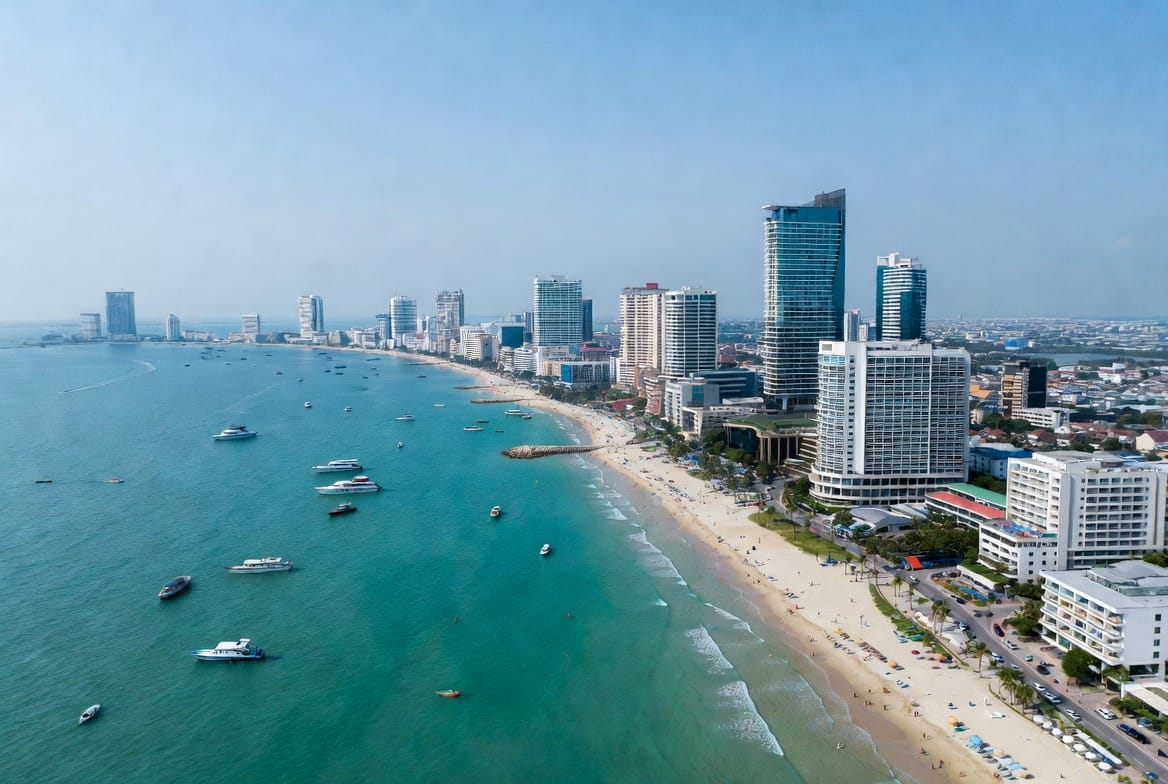
Note on photographs: the image on this page is a general file photograph of the Pattaya area from ThaiThuk’s own library, used for illustration only — it is not a photograph of the arrest scene, which ThaiThuk was unable to license for republication from the original reporting outlets. No AI-generated imagery is used. Note on detail: Mr. Yu has not been convicted of any offence in Thailand and is entitled to the presumption of innocence; the allegations described are those made by investigators. Nothing here is legal advice. This report will be updated as verified information emerges.