Pattaya City, Chonburi
The crackdown that has been circling the islands all year has landed on the mainland
By Genext Information Systems Staff
Published 22 August 2026 • 7 min read
On Friday 21 August 2026, investigators walked into three Pattaya businesses and started copying hard drives. There was no drama, no seizure of assets and — so far — not a single charge. It is still the most consequential Pattaya news story of the month for anyone who owns property here through a Thai company.
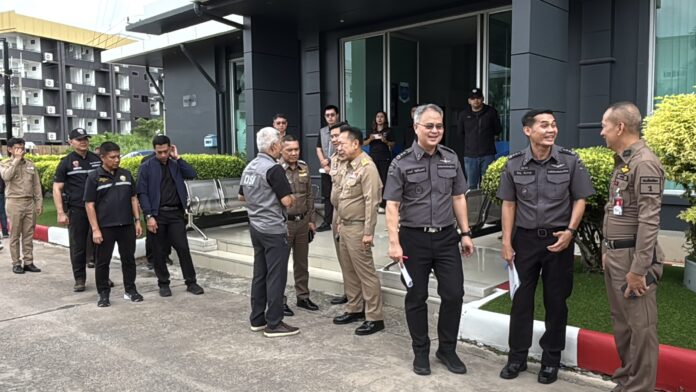
The Department of Special Investigation, the Royal Thai Police and a special operations team from the Department of Provincial Administration searched a law office, a condominium company and a hotel business, all in Pattaya City. The operation was led on the ground by the Justice Minister, Pol. Lt. Gen. Rutthaphol Naowarat, and the Deputy Interior Minister, Worasit Liengprasit, accompanied by the Chonburi governor, Naris Niramaiwong, and the provincial police commander. Ministers do not normally attend searches. Their presence was the message.
No one has been charged, and no company named below has been found to have broken any law. What follows is what investigators say they are examining.
Three doors, one filing cabinet
The three targets were not picked at random. Read together, they describe a complete structure rather than three separate businesses.
The first premises was a legal office, KT International Law and Business. The second was a condominium company, Cosy Beach View Company Limited. The third was a hotel business, Lotus Paradise Development Company Limited, trading as the Shilat Avenue Hotel. Between them, according to investigators, they hold property interests worth several hundred million baht.
Officers took business records, computers and electronic data. Nothing was confiscated and no arrests were made. The file is registered as DSI Special Case 135/2026.
The connective tissue is the law office. In both companies, people associated with that office appear on the shareholder register — and that is the specific thing the investigation is built around.
What the registers show
In Cosy Beach View, an Israeli director holds 49 per cent. Two Thai women hold 25.5 per cent each. One of them reportedly worked for the law office that registered the company, and has appeared in the shareholder records since 2010.
In Lotus Paradise, the owner of the law office and several of its employees are listed as shareholders. A further Thai shareholder appears whose social security records tie her to an aluminium business in Samut Sakhon, some 130 kilometres away.
“Investigation will proceed strictly according to the evidence and the law, ensuring fairness throughout the process,” the DSI said in its statement.
The case in numbers
- 3 — premises searched in Pattaya
- 135/2026 — DSI special case number
- 49% — the foreign shareholding ceiling
- 2010 — year one Thai shareholder first appears
- 48+ — arrests nationwide since May
- 0 — charges filed in Pattaya so far
A 49 per cent company is not illegal. A fake 51 per cent is.
This distinction gets lost in almost every bar-stool version of this story, so it is worth being precise about it.
Foreigners cannot own land in Thailand. They can own a condominium unit outright, provided foreign ownership stays within 49 per cent of the saleable floor area of the building. Beyond that, the common workaround is a Thai limited company: the foreigner takes 49 per cent, Thai shareholders take 51 per cent, and the company buys the land.
That arrangement is perfectly lawful when the Thai shareholders are real. They must have paid for their shares with their own money, be able to show where that money came from, and receive their share of the profits. If they hold the shares on the foreigner's behalf — funded by the foreigner, controlled by the foreigner, returning nothing to themselves — they are nominees, and section 36 of the Foreign Business Act B.E. 2542 (1999) makes that an offence for the Thai nominee and the foreigner alike.
The statutory penalty is imprisonment of up to three years, a fine of 100,000 to 1,000,000 baht, or both, with a further daily fine until the structure is unwound. That is the range on the books, not a prediction of any outcome in this case.
In practice, investigators test the shareholding rather than the paperwork: bank records against declared capital, whether dividends were ever paid, who signs the leases, who actually runs the business day to day. A shareholder whose declared income cannot support the shares she holds is the thread they pull. None of this is legal advice.
If you own through a company, what to check this week
Find out who your shareholders actually are. A surprising number of owners have never met the two Thai names on their register. If they were supplied by the firm that set the company up, that is precisely the pattern under examination.
Ask whether they can evidence the money. The test is not whether the shares are registered but whether the shareholder paid for them and can show it. Bank statements from the time of incorporation are the document that matters.
Look for the tells. Preference shares with weighted voting that hand control back to the 49 per cent holder, blank share transfers held on file, or a loan agreement from the foreigner funding the Thai shares — all of these are read as evidence of a nominee arrangement rather than protection against one.
Get a second opinion from somewhere else entirely. One of the three premises searched on Friday was a law office. If the same firm formed your company, holds your documents and would be advising you now, that is not an independent review.
Know the lawful routes. A condominium in your own name inside the building's foreign quota. A registered 30-year lease. A Board of Investment structure for a real operating business. For Americans, the Treaty of Amity. They are less flexible than a nominee company, which is exactly why the nominee company became common.
If you are earlier in the process and simply working out what a long stay costs and what visa fits it, our guide to entry refusals and Thailand visa and immigration coverage are the sane starting points.
Three months, and Pattaya was always going to be next
Friday's searches were not an isolated Chonburi operation. They are the latest stop on a national campaign that has been running since roughly May, and it has moved steadily through the places where foreign money meets Thai land.
In May, police raided 32 suspected nominee firms on Koh Phangan holding land valued at about 150 million baht. In July, authorities searched 31 suspected nominee companies in Chiang Mai. Also in July, and in Chonburi itself, police dismantled what was described as a Russian-linked property network covering some 775 homes worth around five billion baht. The DSI and the Department of Business Development have since extended the sweep across Koh Samui, Phuket, Phang Nga, Krabi and Surat Thani, with more than 48 arrests and thousands of companies examined.
Israeli nationals have featured heavily in the recent phase — twenty were named in Koh Samui warrants alone — which is context for Friday rather than a conclusion about it.
The pattern worth noticing is the change in target. Early raids went after the companies. This one went after the law office as well. Prosecuting the buyer of a nominee structure removes one owner; prosecuting the firm that manufactures them removes the supply.
What happens next
Investigators will now work through the seized records to establish beneficial ownership against registered ownership: where the capital came from, who received the profits, who exercised control through contracts and daily management, and whether each shareholder's finances plausibly support the stake they hold. That analysis takes months, not days, and charges may or may not follow.
For the rest of Pattaya, the useful signal is not the outcome of one case. It is that a structure tens of thousands of foreign residents rely on is now being tested by a unit with the powers of a special investigation, in person, with a minister standing in the doorway. ThaiThuk will update this report as the case proceeds.
Staying legally
Get the visa right before you get the property wrong
Most people who end up in a nominee structure started by needing somewhere to live on the wrong visa. Work out which permission actually fits your plans with ThaiVisaFinder, and price the stay honestly with ThaiBudgetPlanner.
Find your visa →
Written by
Genext Information Systems Staff
ThaiThuk's editorial team at Genext Information Systems — writers and long-term residents based in Thailand who report from the ground on Thai culture, travel, food and community. Every piece is checked against primary sources and updated as details change. More about ThaiThuk →
Sources
- The Pattaya News — "DSI Raids Three Large Suspected Nominee Networks Holding Land and Businesses Worth Hundreds of Millions of Baht for Foreigners in Pattaya", 21 August 2026.
- Thai Examiner — "Raids in Pattaya on Friday led by two ministers targeting Israeli business networks and legal advisors", 22 August 2026, for the company names, shareholding percentages and DSI case number.
- Thai Examiner — "Massive Russian nominee property empire smashed by police in Chonburi. 775 homes worth 5 billion baht", 17 July 2026.
- Bangkok Post — "DSI raids 5 island spots as nominee probe expands", and Nation Thailand reporting on the Koh Samui and Koh Phangan operations.
- The Pattaya News — "Police Raid 32 Suspected Nominee Firms Holding Land Worth 150 Million Baht on Koh Phangan", 14 May 2026.
- Foreign Business Act B.E. 2542 (1999), section 36, for the nominee offence and the penalty range quoted above.
Note on photographs: the lead image is a press photograph published by The Pattaya News (TPN Media) with its reporting on this operation, reproduced here for news reporting with credit to that source. The shareholding diagram is original ThaiThuk artwork drawn from figures reported by Thai Examiner. No AI-generated imagery is used. Note on detail: no person or company named in this report has been charged with any offence, and all are entitled to the presumption of innocence; the shareholding details described are what investigators are said to be examining, not established findings. Official names are transliterated from Thai and appear in varying forms across sources. The penalty range is the statutory maximum under the Foreign Business Act, not a prediction, and nothing here is legal advice. This report will be updated as verified information emerges.