
Naklua, Banglamung, Chonburi
A grill, a rain tree and ninety seconds of very bad luck
By Genext Information Systems Staff
Published 22 August 2026 • 6 min read
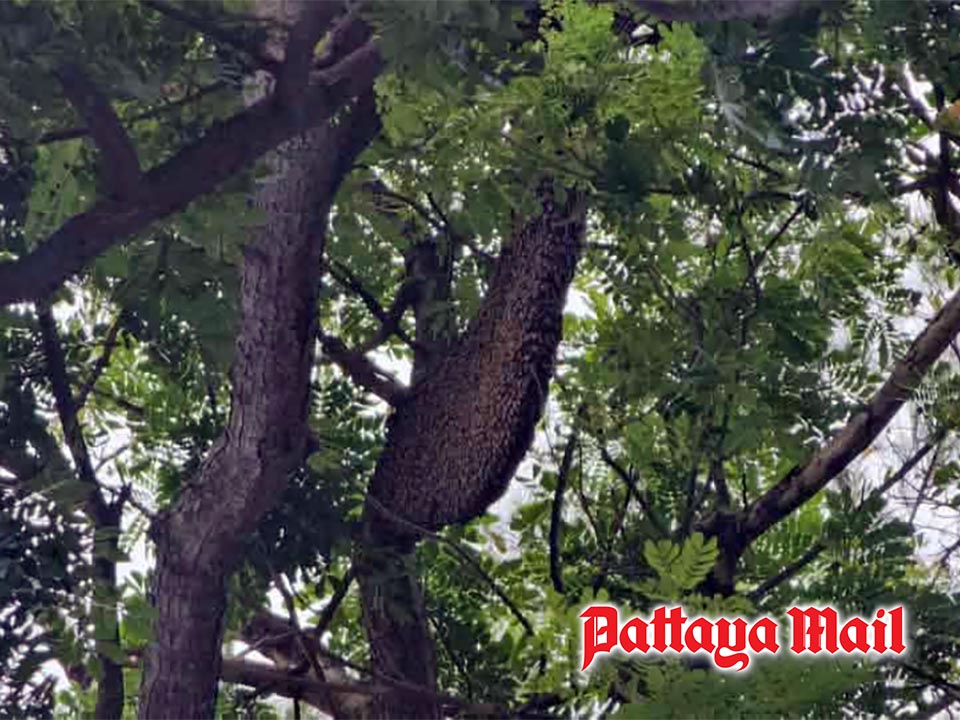
At about 10.20am on Thursday 20 August 2026, a food vendor outside the Banglamung district office lit a charcoal fire to grill chicken. Directly above her, high in a rain tree, hung a colony of giant honey bees in a single open comb roughly a metre across.
Within minutes seventeen people had been stung badly enough to need an ambulance. Thirteen of them were pupils at Banglamung School.
The site is a shared government compound in Naklua: the district office, Banglamung police station and the school all sit within the same few hundred metres. That is the whole story in one sentence — the nest was hanging over a place where several hundred children, officials and market traders pass every single day.
What happened outside the district office
Two things went wrong at once, and the second is the one worth remembering.
The first was the fire. Smoke rising into an open-nesting colony is a recognised trigger, and reports of the incident put the grill directly beneath the comb. The swarm came down in a matter of moments.
The second was a power cut. The outage had forced Banglamung School to close early and send its pupils out — which is why thirteen children were crossing that compound at 10.20 on a Thursday morning rather than sitting in class. Nobody arranged that. It is simply the difference between a nasty incident involving two market traders and a mass-casualty call.
Worst hurt was Oranong Ventris, 71, a food vendor known locally as Aunt Auan. Reports describe hundreds of bees surrounding her; she was stung, by one account, more than a hundred times, and collapsed where she stood.
The officer who went in
A police officer from the adjacent station ran into the swarm to pull her clear. Accounts name him as Ratchaphol Senee Wong Na Ayutthaya, giving his rank variously as police captain and police lieutenant colonel. He grabbed a fire extinguisher and sprayed it at the bees to drive them back. He was stung himself and was among the seventeen treated.
More than five Sawang Boriboon rescue ambulances attended. Victims were given first aid at the scene for swelling and allergic reactions and taken to hospital in Banglamung.
Later the same day, workers brought in a basket lift, removed the nest from the tree and destroyed it.
The incident in numbers
- 17 — people injured
- 13 — of them Banglamung School pupils
- 1m — width of the nest comb
- 71 — age of the worst-injured vendor
- 5+ — rescue ambulances sent
- 1669 — Thai emergency medical number
Why a giant honey bee nest is not a wasp nest
Giant honey bees — phueng luang in Thai — build very differently from the boxed hives most visitors picture. A colony hangs a single exposed comb from a high branch or a building overhang, with the bees themselves forming a living curtain several layers thick across its face. A large comb can hold tens of thousands of individuals.
Because the nest is open rather than enclosed, the colony's entire defence is the swarm. They are markedly more reactive than the domesticated honey bees kept in hives, they respond as a mass rather than individually, and they will pursue a perceived threat well beyond the tree.
Individually the sting is no worse than any other bee's. The danger is arithmetic. A person who takes dozens or hundreds of stings receives a dose of venom that becomes a systemic problem regardless of whether they are allergic — and anyone who is allergic can be in serious trouble after one. That is why a 71-year-old woman stung repeatedly is the most serious casualty here, and why thirteen children caught in the open was a genuinely dangerous situation rather than a painful one.
Smoke and vibration are both known to provoke them. So is anything that shakes the branch. The colonies are seasonal and migratory, which is precisely why a tree that was clear a few months ago can be carrying a metre of comb by August.
If a swarm comes down near you
Run, and keep running. The instinct to freeze or swat is exactly wrong. Get indoors or into a vehicle. These bees will follow, so distance matters more than cover — a hundred metres is better than ten.
Cover your face and neck, not your body. Pull a shirt over your head if you have nothing else. Stings to the face, mouth and throat are the ones that cause airway problems.
Do not jump into water. A swarm will wait above the surface. This is one of the few pieces of folk advice that reliably makes things worse.
Do not light anything under a tree you have not looked up into. This is the specific mistake that started Thursday, and it is a very easy one to make at a roadside stall.
Call 1669. That is Thailand's emergency medical line, and it is what brought five ambulances to Naklua inside a few minutes. For anything involving foreigners, tourist police on 1155 speak English.
Report a nest rather than dealing with it. Removing a metre-wide comb is a basket-lift job for people with equipment. District offices and municipal fire crews handle these, and a phone call is free.
The part that should not be filed under freak accident
Residents told reporters there had been bee incidents at this location before. Thursday's was described as considerably more severe — but the phrasing matters. It was not the first. The colony had been in that tree long enough to build a comb a metre wide, hanging over a compound containing a school, a police station and a district office.
Nothing about that requires hindsight to notice. An exposed nest of that size in a public compound is visible from the ground, and removing one is routine municipal work — as demonstrated by the fact that it took a few hours once seventeen people were in ambulances.
The honest reading is not that Pattaya has a bee problem. It is that a known, visible, removable hazard sat above a school run until it stung thirteen children, and that the reason it became a mass-casualty incident rather than a two-person one was an unrelated power cut. That is a maintenance story wearing a wildlife story's clothes.
What we still do not know
Officials said further details remained under investigation. As of publication, ThaiThuk has not been able to confirm the current condition of Oranong Ventris or of the students treated, and no authority has published a follow-up on their recovery. Nor has anything been announced about surveying the remaining trees on the compound, which is the one measure that would stop this recurring.
The nest is gone. Giant honey bee colonies are migratory and they return to good sites. ThaiThuk will update this report if the district announces a survey, or when the condition of those injured is confirmed.
Before you travel
The boring paperwork that matters on a bad day
Seventeen ambulance rides is a reminder that medical cover is not optional here. Work out the shape and cost of your trip with ThaiBudgetPlanner, and check which permission actually fits your stay with ThaiVisaFinder.
Price out your trip →
Written by
Genext Information Systems Staff
ThaiThuk's editorial team at Genext Information Systems — writers and long-term residents based in Thailand who report from the ground on Thai culture, travel, food and community. Every piece is checked against primary sources and updated as details change. More about ThaiThuk →
Sources
- Pattaya Mail — "17 injured after giant bees attack Pattaya market", 21 August 2026, for the timing, the grill, the casualty breakdown and the nest removal.
- The Pattaya News — "Giant Honey Bees Swarm in Pattaya Area, Sting 17 People Including Elderly Vendor, School Students, and Police Officer", 21 August 2026.
- Thai Examiner — "Hundreds of giant bees attack 17 people at a Chonburi government complex", 21 August 2026, for the compound layout, the power cut and the fire-extinguisher rescue.
- Bangkok Post — "Students injured by swarming bees", 21 August 2026.
- Sawang Boriboon Thammasathan rescue foundation, attending units, via the reporting above.
Note on photographs: both images on this page are press photographs published by Pattaya Mail with its reporting on this incident, reproduced here for news reporting with credit to that source. No AI-generated imagery is used. Note on detail: sources differ on two points and we have not resolved them independently — the attending officer's rank is given as both police captain and police lieutenant colonel, and one outlet dates the incident 21 August while others place it on Thursday 20 August, which is the date used here. The figure of more than one hundred stings for the worst-injured vendor comes from a single report. No medical update on any of those injured had been published at the time of writing. Advice in this article is general safety information, not medical advice; anyone stung repeatedly or showing breathing difficulty should get emergency care immediately on 1669.